
What Does "End-to-End Encryption" Actually Mean for Your Texts?
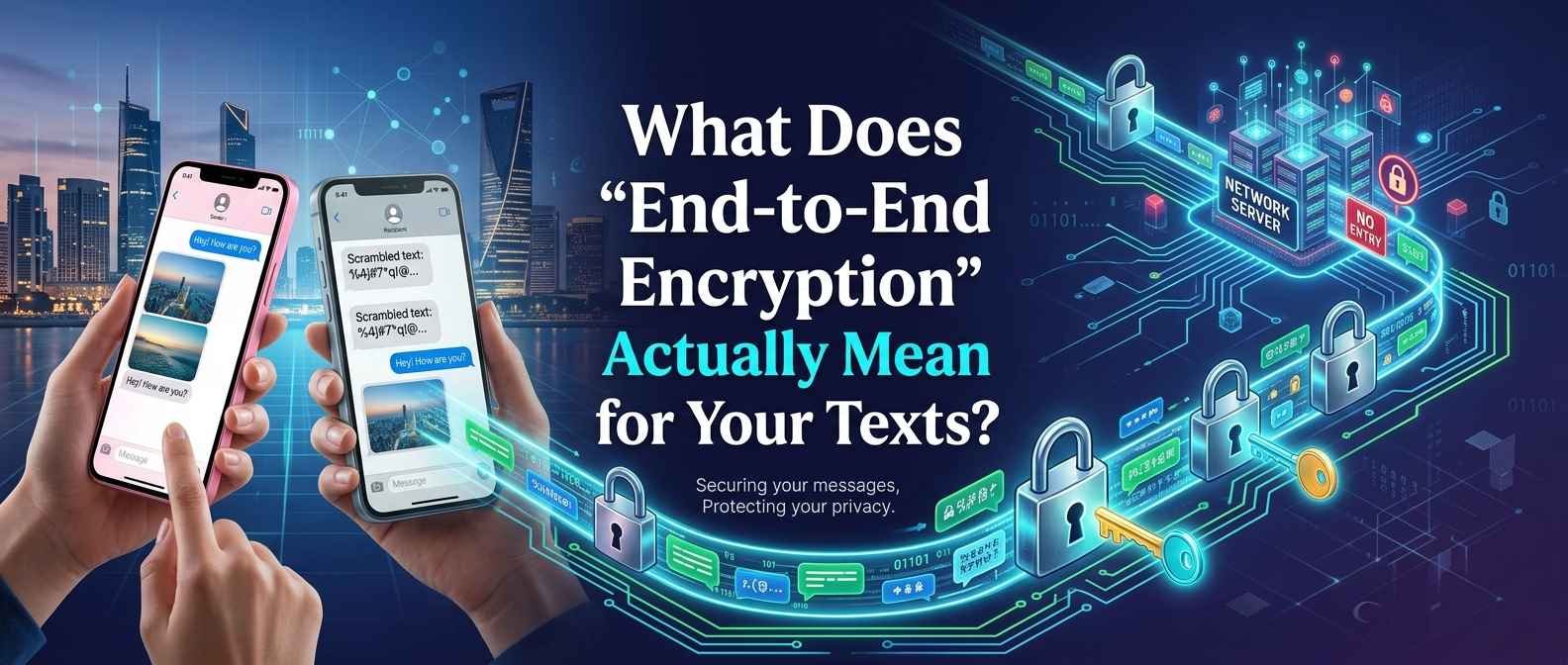
You've probably seen the little notice at the top of a chat: "Messages are end-to-end encrypted." But what does that actually protect you from — and who exactly couldn't read your messages before?
Apps like WhatsApp, iMessage, and Signal all advertise "end-to-end encryption" as a headline feature. It sounds reassuring, but if you've ever wondered what it actually means — and more importantly, who it's protecting you from — you're not alone. It's one of those phrases that gets used constantly without much explanation.
Let's break it down properly, starting with the problem it's solving.
First: What Happens to a Message Without Encryption?
When you send a text message, it doesn't teleport directly from your phone to your friend's phone. It travels through a chain of infrastructure to get there — cell towers, internet providers, and often the servers belonging to the app or company you're using to send it.
If a message travels through that chain without encryption, it's a bit like sending a letter through the mail with no envelope — just a piece of paper anyone handling it along the way could casually read. Old-school SMS text messages (the plain green/blue bubbles with no extra protection) work roughly this way: they're not strongly protected, and in principle, could be intercepted and read by someone with the right access at various points along the delivery chain.
What Encryption Adds
Encryption scrambles a message into unreadable gibberish using a mathematical process, so that anyone who intercepts it along the way just sees nonsense — unless they have the specific "key" needed to unscramble it back into readable text.
But here's the important nuance: not all encryption is the same, and this is exactly where "end-to-end" encryption becomes a meaningfully different — and stronger — promise than regular encryption.
Regular Encryption vs. End-to-End Encryption
Many services encrypt your messages while they're traveling to their servers — this is often called "encryption in transit." It's a genuine improvement over sending things completely unprotected. But there's a catch: the company's own servers still hold the key to unscramble the message once it arrives, since they need to be able to read it in order to process it, store it, and forward it to the right recipient.
That means with regular encryption, your message is protected from outside eavesdroppers on the way there — but the company running the app could still technically read your messages themselves, since they hold the decryption key.
End-to-end encryption removes even that possibility. With true end-to-end encryption:
- Your message is scrambled on your device, before it ever leaves your phone
- It travels across the internet and through the company's servers still scrambled
- It only gets unscrambled on your recipient's device, using a key that only their device has
The phrase "end-to-end" refers to exactly this: the message is protected for its entire journey, from one end (your device) to the other end (your recipient's device) — with no stop along the way, including the company's own servers, where it exists in a readable form.
The Lock-and-Key Idea Again
Similar to how passkeys work (a topic worth its own read if you're curious), end-to-end encryption relies on each device holding its own private key that never gets shared with anyone — including the company running the app.
When you send a message, your app locks it using a key tied specifically to your recipient. Only their device holds the matching key needed to unlock it. The company relaying the message in the middle is essentially just handing along a locked box — they can see that a box was sent, and roughly when, but they can't see what's inside it.
So Who, Exactly, Can't Read Your Messages?
This is really the heart of why end-to-end encryption matters. With it properly in place:
- The company running the app (like Meta for WhatsApp, or Apple for iMessage) can't read the actual content of your messages, even if they wanted to, or even if legally compelled to hand over message content — because they simply don't hold the key required to unscramble it.
- Anyone intercepting the message along its journey — whether on public Wi-Fi, through an internet provider, or anywhere else along the path — sees only scrambled data.
- Hackers who breach the company's servers would find encrypted, unreadable messages sitting there, rather than a treasure trove of plain-text conversations.
What End-to-End Encryption Doesn't Protect You From
It's worth being clear-eyed about the limits here too, since encryption is often oversold as a cure-all:
- It doesn't protect the message once it's visible on-screen. If someone is looking over your recipient's shoulder, or their phone is unlocked and in someone else's hands, encryption isn't doing anything to stop that — the message has already been unscrambled for viewing at that point.
- It doesn't necessarily hide metadata. Things like who you're messaging, when, and how often can sometimes still be visible to the company, even if the actual content of the conversation is protected. Different apps handle this differently — some are much more careful about minimizing metadata collection than others.
- It doesn't protect against malware on your own device. If someone's phone is compromised with spyware, an attacker could potentially read messages directly on the device, before encryption is even applied, or after it's unscrambled to display them.
- It only works if both people are using it. If you send an end-to-end encrypted message from one app to someone using a completely different, non-compatible system, that protection typically doesn't carry over.
Why the Little Notice Matters
This context explains why apps like Signal and WhatsApp make a point of showing that little "messages are end-to-end encrypted" banner — it's a genuinely meaningful claim, not just marketing fluff. It's a direct statement that even the company itself has deliberately designed its system so that it cannot read your conversations, even if it wanted to.
That's also why it matters when you see reports about certain messaging services not offering end-to-end encryption by default (regular SMS text messages, for instance, or some messaging features that only apply encryption in transit) — the protection you're getting can vary a lot depending on which app or feature you're actually using.
The Takeaway
End-to-end encryption is a specific, strong promise: your message is scrambled the moment it leaves your device, stays scrambled the entire time it's traveling — including while it's sitting on the company's own servers — and only becomes readable again on your recipient's device. It's the difference between a sealed letter that only the recipient can open, and a postcard that anyone handling it along the way could glance at. Knowing the difference helps you understand exactly what kind of privacy you're actually getting — and just as importantly, what you're not.