
A Beginner-friendly Look at Search Engines and Indexing
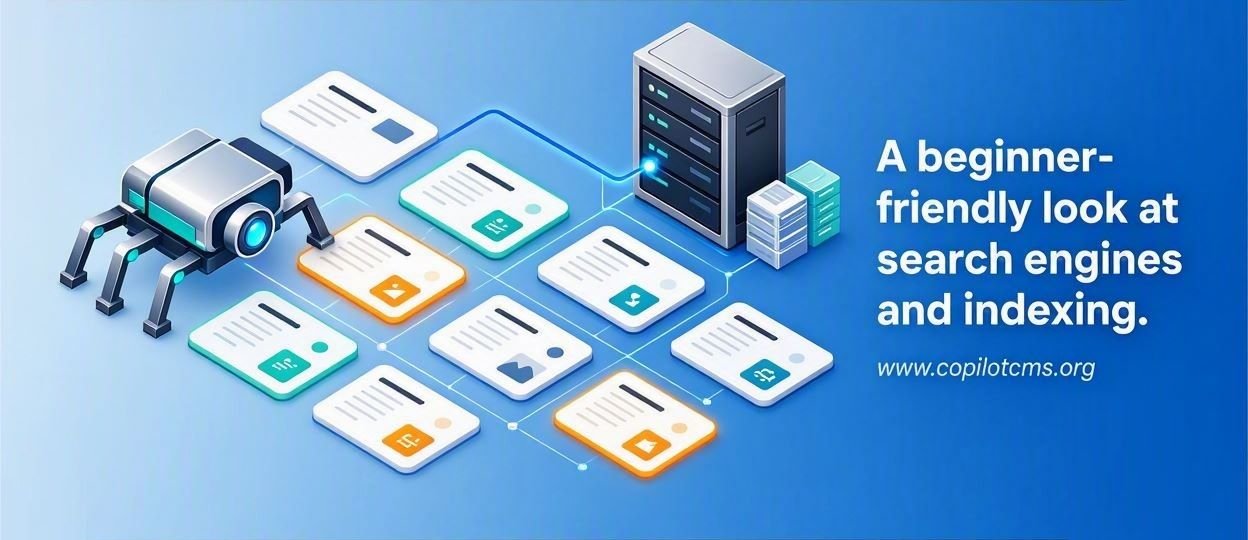
Whenever you type a question into Google or another search engine, it can seem as though the answer appears instantly from nowhere. In reality, search engines have already spent enormous amounts of time discovering, reading, organizing, and storing information from across the web so they can find useful pages when you need them.
What Is a Search Engine?
A search engine is a service that helps you find information on the internet. You type words or a question into a search box, and the search engine returns a list of web pages that it believes are relevant to what you are looking for.
Google is the search engine most people are familiar with, but it is not the only one. Other examples include Bing, DuckDuckGo, and Brave Search.
It is important to understand one thing from the beginning: a search engine is not the same thing as the internet.
The internet is the enormous network connecting computers and devices around the world. The web is the collection of websites and pages that we access through that network. A search engine is a tool that helps us find our way through a portion of that enormous collection.
The Real-World Version: A Giant Library
One of the easiest ways to understand search engines is to imagine a gigantic library.
Imagine walking into a library containing billions of books. You want to know how plants turn sunlight into energy, but you have no idea which book contains the answer.
You could walk through every shelf and open every book until you found something useful. Obviously, that would take far too long.
Instead, imagine that the library has a highly organized catalog. The catalog records which books exist, what subjects they cover, which words and topics they contain, and where each book can be found.
You tell the librarian, "I want information about how plants use sunlight," and the catalog helps the librarian quickly identify books that are likely to contain the information you need.
A search engine works in a broadly similar way.
- The web pages are like books in the library.
- Search engine crawlers are like assistants who discover and examine books.
- The search index is like the library's enormous catalog.
- Your search query is like asking the librarian a question.
- Search results are the books or pages the librarian thinks are most useful.
There is one major difference, however: the web is constantly changing. New pages appear, old pages disappear, and existing pages are modified every minute. Search engines therefore have to keep discovering and updating information continuously.
How Does a Search Engine Know About Websites?
This is where the idea of crawling comes in.
Search engines use automated computer programs, commonly called crawlers, spiders, or bots, to discover web pages.
These programs visit web pages and follow links from one page to another. In this way, they can discover large numbers of pages without someone having to manually enter every website into a database.
Imagine a Web of Roads
Think of the internet as a huge collection of cities connected by roads.
Each website is like a city, and each web page is like a building within that city. Links between web pages are like roads connecting different places.
A crawler arrives at one page, examines it, and finds links leading to other pages. It can then follow those links and discover more pages.
That is one reason links are so important on the web. They do not merely give humans something to click. They also provide pathways that help automated systems discover related pages.
What Is Crawling?
Crawling is the process through which a search engine's automated systems discover and visit web pages.
Suppose you publish a new article on your website. The search engine may not know about that page immediately. Eventually, however, a crawler may discover the page through a link from another page, a sitemap, or other signals.
When the crawler visits the page, it can examine things such as:
- The text on the page
- The page title
- Headings and other page structure
- Links to other pages
- Images and information associated with them
- Other information that helps describe the page
The crawler does not necessarily behave like a human sitting in front of a browser and reading every sentence carefully. It is an automated system designed to process enormous amounts of information efficiently.
What Is Indexing?
After discovering a page, a search engine may process and store information about it in an index.
This process is called indexing.
The word "index" may sound complicated, but the basic idea is familiar. Think about the index at the back of a large textbook.
If you want to learn about gravity, you do not normally read the entire textbook from beginning to end. You look in the index for words such as "gravity," "mass," or "acceleration." The index points you toward relevant pages.
A search engine's index is vastly more complicated, but the basic purpose is similar: it helps the search engine organize information about web pages so that relevant pages can be retrieved when someone searches.
Crawling and Indexing Are Not the Same Thing
These two terms are often confused.
Crawling means discovering and visiting a page.
Indexing means processing information about that page and potentially adding it to the search engine's searchable database.
A simple way to remember the difference is:
Crawling is discovering the book. Indexing is organizing information about the book in the catalog.
A search engine can crawl a page without necessarily showing that page in search results. Discovery and inclusion in the index are related, but they are not identical.
What Is a Search Index?
A search index is a huge, organized collection of information about web content that a search engine has discovered and processed.
It is not simply a giant copy of the internet stored in alphabetical order. Modern search engines use sophisticated systems to understand and organize information in many different ways.
For example, when processing a web page about bicycles, a search engine may identify that the page contains information related to bicycles, cycling, bicycle maintenance, components, safety, and other topics.
When someone later searches for "how to fix a bicycle chain," the search engine can use information in its index to identify pages that may be useful.
Why Doesn't a Search Engine Simply Search the Entire Web Every Time?
Imagine asking a librarian a question and having the librarian respond, "Give me ten minutes while I check every book in the building."
That would make the library practically useless.
Search engines face a much larger version of the same problem. The web contains an enormous amount of information, and searching every page from scratch for every user would be far too slow and inefficient.
Instead, search engines prepare in advance. They crawl and process pages ahead of time and build an index that can be searched quickly.
When you enter a query, the search engine is therefore not normally starting its investigation from zero. It is searching through information that has already been collected and organized.
What Happens When You Search?
Let's follow a simple search from beginning to end.
Suppose you type:
how does a refrigerator work
Step 1: You Enter a Query
Your words are called a search query.
A query can be a single word, such as "weather," a few words such as "best laptops," or a complete question such as "How does a refrigerator keep food cold?"
Step 2: The Search Engine Interprets the Query
The search engine tries to understand what you mean.
This is more complicated than simply looking for pages containing exactly the same words you typed. People use different words to express the same idea, and many words have multiple meanings.
For example, someone searching for "apple" might be looking for information about the fruit or the technology company. The search engine has to use context and other signals to determine what results are likely to satisfy the user's intention.
Step 3: The Search Engine Looks Through Its Index
The search engine searches its index for pages that appear relevant to the query.
It does not necessarily need to revisit every website on the internet at that moment. Much of the work of discovering and processing pages has already happened.
Step 4: The Search Engine Ranks Potential Results
The search engine may find thousands, millions, or even billions of pages that are related in some way to a query.
It therefore needs to decide which pages should appear near the top.
This process is known as ranking.
Search engines use many signals and systems to determine which results are likely to be useful, relevant, reliable, and appropriate for a particular search.
Step 5: You See the Results
The search engine presents a results page containing links and other information that may help answer your question.
You click a result, visit the web page, and hopefully find what you were looking for.
Crawling, Indexing, and Ranking: The Three Ideas to Remember
These three concepts form a useful mental model for understanding search engines.
- Crawling: Discover and visit web pages.
- Indexing: Process and organize information about those pages.
- Ranking: Decide which relevant pages should be presented prominently for a particular search.
You can think of the whole process as a library:
- A library worker discovers a new book.
- The worker records information about the book in the catalog.
- When a visitor asks a question, the librarian uses the catalog to find suitable books and recommends the most useful ones.
That is not exactly how a modern search engine works internally, but it is a useful beginner-friendly model.
Does Being Indexed Mean a Page Will Appear First?
No.
This is one of the most important distinctions for beginners.
Being indexed does not mean being ranked highly.
Imagine that your book has been successfully added to a library's catalog. If someone searches the catalog for "history of computers," your book might appear somewhere in the list. That does not mean the librarian will place it on the first shelf the visitor sees.
Similarly, a web page can be indexed but appear far down in search results for a particular query.
Indexing is essentially about being available to the search engine's search system. Ranking determines where a relevant page may appear for a particular search.
Can a Search Engine Index Every Page on the Web?
No search engine should be thought of as having a perfect, complete copy of everything on the internet.
The web is enormous and constantly changing. Some pages are difficult to discover, some require special access, some are deliberately excluded from search engines, and some may not be considered useful enough to include.
There are also parts of the internet that search engines cannot access in the same way they access ordinary public web pages. Private accounts, password-protected areas, and certain dynamically generated or restricted content are examples.
Why Isn't My New Web Page Showing in Search?
If you publish a page and cannot find it in a search engine immediately, that does not necessarily mean something is broken.
Several things could be happening.
The Page Has Not Been Discovered Yet
A search engine may simply not have discovered the new page yet.
This is especially possible when a website is new or when the page has few or no links pointing to it.
The Page Has Been Discovered but Not Indexed
A crawler may have visited a page, but the page may not yet be included in the search engine's index.
Discovery and indexing are separate stages.
The Page Is Indexed but Hard to Find
Your page may already be indexed but rank poorly for the words you are searching.
In that case, the issue is not necessarily indexing. It may be a ranking or relevance issue.
The Page May Be Intentionally Excluded
Website owners can give search engines instructions that affect whether certain pages should be crawled or indexed.
For example, a website might deliberately keep an administration page, duplicate page, or private-looking section out of search results.
What Is a Sitemap?
A sitemap is a file that can provide search engines with information about the URLs that are important on a website.
Think of a sitemap as giving the librarian a map of your building.
Without a map, the librarian might still discover many rooms by walking around and following signs. But a useful map can make it easier to understand what rooms exist and where they are located.
A sitemap does not guarantee that every listed page will be indexed or rank well. It is better understood as a helpful discovery and organizational signal rather than a command saying, "Put these pages in the search results."
What Are Links and Why Do They Matter?
Links are one of the fundamental building blocks of the web.
Suppose you write an article about computer history and link to another article explaining the invention of the transistor. That link creates a connection between the two pages.
Search engine crawlers can follow such connections to discover content. Links can also provide context about how pages relate to one another.
In our library analogy, links are like references between books: "For more information about this subject, see Book 42."
However, not every link has equal importance, and simply creating huge numbers of links is not a shortcut to good search rankings.
What Does "Search Engine Optimization" Mean?
You may have heard the term SEO, which stands for Search Engine Optimization.
SEO is the broad practice of making a website and its content easier for search engines to understand and, where appropriate, easier for people to discover through search.
For a beginner, it is helpful to think of SEO less as "tricking Google" and more as making your website a well-organized library.
A well-organized article has a clear title, useful headings, understandable writing, meaningful links, and information that actually answers the reader's question.
Good SEO also involves technical aspects of a website, accessibility, page performance, mobile usability, structured information, and many other considerations. But the basic principle is simple: help both people and search engines understand what your page is about.
Why Search Results Can Be Different for Different People
You and another person can sometimes enter the same search query and receive somewhat different results.
Search systems can consider factors such as location, language, device, freshness of information, and the particular meaning inferred from the query.
For example, someone searching for "pizza near me" in Lahore needs different results from someone making exactly the same search in London.
This is another reason why search results should not be thought of as a single permanent list. They are generated in response to a particular search situation.
Why Search Results Change Over Time
Search results are not frozen forever.
Web pages are constantly being published, updated, moved, or deleted. Search engines also improve the systems they use to understand content and rank results.
Imagine a library whose collection changes every day. New books arrive, old editions are replaced, and some books become more useful because current events have made their subjects important.
The catalog therefore needs to be updated continuously.
Search engines face the same basic challenge on a much larger scale.
Search Engines Are More Than a List of Keywords
An old-fashioned way of imagining a search engine would be to picture a giant box containing words. You type "computer," and the system simply finds pages containing the word "computer."
Modern search systems are considerably more sophisticated than that.
They attempt to understand language, relationships between concepts, the meaning behind queries, the usefulness of pages, and many other signals.
For example, if you search for "why is my phone battery dying quickly," you are not necessarily looking for pages containing those exact words in exactly that order. You are looking for information that addresses the underlying problem.
A good search system therefore needs to connect your question with useful information, even when the wording is not identical.
What About AI and Search?
Modern search engines increasingly use artificial intelligence and machine-learning systems to understand queries and web content.
For beginners, however, it is useful to separate the basic search-engine process from the particular technologies used to implement it.
The fundamental problem remains the same: discover information, organize it, understand what a person is asking, and provide useful results.
AI can make those processes more sophisticated, but it does not eliminate the need for crawling, indexing, retrieval, and ranking.
Why This Matters If You Have a Website
If you run a website or write a blog, understanding search engines changes the way you think about publishing.
Publishing an article does not automatically mean that millions of people will discover it. There is a chain of events between writing the article and appearing in search results.
- Your page must be accessible to search-engine systems.
- A crawler needs to discover the page.
- The search engine needs to process and potentially index it.
- The page needs to be considered relevant to a particular search.
- The search engine then determines where it belongs among other relevant results.
This explains why creating useful content is only part of building a discoverable website. Good site structure, navigation, links, clear writing, and appropriate technical configuration can also matter.
A Simple Troubleshooting Checklist
If a page you published is not appearing in search, start with the basics rather than immediately assuming that something is wrong with your SEO.
- Check that the page actually exists and loads normally.
- Make sure the page is not accidentally blocked from search engines.
- Check whether the page can be reached through links on your website.
- Make sure your site's important pages are represented appropriately in its sitemap.
- Give newly published pages some time to be discovered and processed.
- Check whether the page is indexed before worrying about its ranking.
- Consider whether your search query is actually relevant to the page.
- Remember that being indexed does not guarantee a high position in search results.
Search-engine tools provided for website owners can also help diagnose crawling and indexing problems. For example, Google's Search Console provides information about how Google discovers and processes pages on a website.
A Simple Mental Model to Remember
If all of this seems like a lot, remember this four-part picture:
- Discover: A crawler finds a web page.
- Understand: The search engine processes what the page contains and what it is about.
- Store: Useful information about the page can be added to the search index.
- Retrieve and rank: When someone searches, the search engine finds relevant pages and decides which results to show prominently.
In our library analogy, it is the difference between finding a new book, cataloging it, putting its information into the library system, and then recommending it when a visitor asks the right question.
The Takeaway
A search engine is essentially a sophisticated system for helping people find information on the web. It uses automated crawlers to discover pages, processes those pages and stores useful information in an index, and then uses that index to find and rank relevant results when someone searches.
The most important distinction to remember is the difference between crawling, indexing, and ranking. A page must first be discovered, it may then be indexed, and only after that does the question of how prominently it appears for a particular search become relevant.
Once you understand those three ideas, search engines become much less mysterious. Instead of imagining that Google somehow searches the entire internet in an instant, you can picture something much more understandable: a gigantic, constantly updated catalog that has already done much of the organizing work before you ever type your question.