
What Happens When You Ask an AI a Question? From your keyboard to the model and back
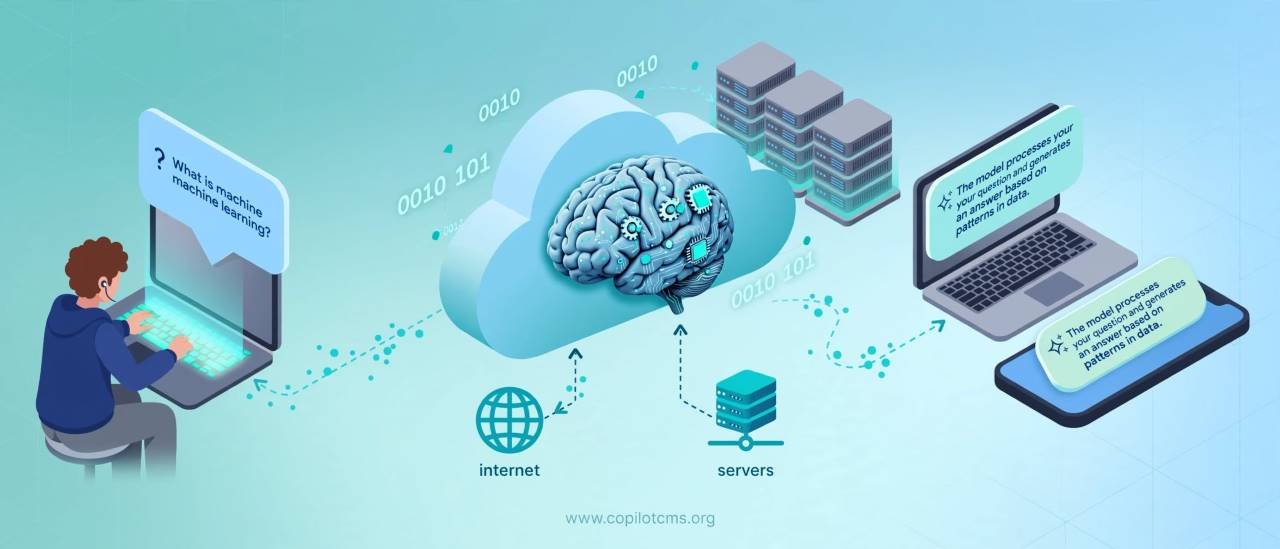
When you type a question into an AI chatbot, it can feel as though you are simply “talking” to a very smart person. But behind that simple conversation is a surprisingly long journey—from your keyboard, through the internet and computer systems, into the AI model, and finally back to your screen.
The Big Picture: Your Question Goes on a Journey
Suppose you type:
“Why is the sky blue?”
What happens next is not simply that the AI “reads” your sentence and thinks about it like a human. Your question passes through several stages before an answer appears.
In simplified form, the journey looks something like this:
- You type the question.
- Your device turns your keystrokes into digital data.
- The app or website prepares your message for transmission.
- Your message travels across a network to the AI service.
- The service sends the relevant information to an AI model.
- The model processes the input and predicts an appropriate response.
- The generated response is sent back across the network.
- Your device receives the data and displays the answer.
The whole process can happen in seconds—or sometimes much less.
Step 1: You Type a Question
It all begins with something extremely ordinary: your fingers pressing keys.
When you type a sentence such as “How does Wi-Fi work?”, your computer or phone doesn't store your keystrokes as tiny pieces of physical paper. It represents the characters as digital information—patterns of numbers that computers can work with.
The keyboard itself is essentially a collection of switches. Pressing a key tells the computer which key was pressed, and the operating system and application interpret that information as a character or action.
By the time your sentence appears in the text box, your computer has already translated your physical actions into digital information.
The Real-World Version
Imagine filling out a paper form.
You physically hold a pen and write, “How does Wi-Fi work?” But before someone can process your request, the writing has to become information that an office can handle.
Your keyboard is like the pen, while the computer is the office worker turning your actions into organized information.
Step 2: The App or Website Prepares Your Message
Once you press the button to send your question, the application—such as an AI chatbot website or app—takes over.
It doesn't simply throw your words randomly onto the internet. The application packages the information into a form that the AI service's computers can understand.
Depending on the service, the request can include more than the words you just typed. For example, the system may need information about the conversation you're currently having, instructions that control how the AI should behave, or other information required to process the request.
This is one reason an AI can sometimes appear to “remember” what you said earlier in a conversation. The model may receive relevant earlier messages as part of the information provided to it.
Step 3: Your Question Travels Across the Internet
Now your question has to get from your device to the computers running the AI service.
This is where the internet comes in.
If you're using Wi-Fi, your device first communicates with your wireless router. The router connects to your internet service provider, which connects you to other networks. Eventually, the request reaches the infrastructure operated by the AI service or its cloud provider.
Your message may cross multiple pieces of networking equipment along the way.
Think of It Like Sending a Parcel
Imagine mailing a small package from your home to a warehouse on the other side of the country.
You don't personally drive the package all the way there. You hand it to a delivery system. It may pass through a local facility, a regional sorting center, another distribution center, and finally the destination warehouse.
Internet data works in a similar broad sense. Information is divided into pieces and moved through networks toward its destination.
The internet doesn't consist of one enormous cable connecting every computer directly to every other computer. It is a gigantic collection of interconnected networks.
Step 4: The Request Reaches the AI Service
Eventually, your request reaches the computer infrastructure responsible for handling it.
This is where things become much more interesting.
An AI chatbot is not normally running entirely on the computer sitting on your desk. The large AI model may be running on powerful servers in a data center.
A data center is essentially a facility containing large numbers of computers, along with networking equipment, cooling systems, power systems, and other infrastructure needed to keep those computers operating.
These computers can be vastly more powerful than an ordinary home PC because AI models can require enormous amounts of computing power.
Step 5: Your Words Are Turned Into Tokens
Here's one of the most important details: an AI model doesn't receive your sentence in quite the same way you experience it.
Before the model processes your message, the text is broken into pieces called tokens.
A token is a unit of text that the model can process. Depending on the tokenizer and the language, a token might correspond roughly to a word, part of a word, punctuation, or another small piece of text.
For example, a short sentence might be divided into several pieces rather than treating the entire sentence as one indivisible object.
The exact tokenization depends on the particular AI model and its tokenizer.
Why Not Just Use Whole Words?
Because language is messy.
Consider these words:
- computer
- computers
- computerized
- computing
If an AI system had to store every possible word separately, the vocabulary would become enormous.
Breaking text into reusable pieces allows a model to deal with words it has never encountered in exactly that form.
The Real-World Version
Imagine a warehouse where workers sort packages.
Instead of treating every possible sentence written on a package as one unique object, the warehouse has standardized labels and categories. Those smaller pieces of information make it easier for the system to organize and process what has arrived.
Tokens play a somewhat similar role for an AI model.
Step 6: Tokens Become Numbers
There is another important transformation.
Computers are exceptionally good at mathematical operations, but an AI model cannot directly perform its calculations on the abstract idea of the English word “elephant.” The token is represented numerically so that the model can perform calculations on it.
This is one of the central ideas behind modern machine learning: information that humans think of as words, images, sounds, or other concepts can be represented as numbers that mathematical systems can process.
The numbers aren't simply a dictionary definition of each word. The model's internal representations can capture relationships and patterns learned during training.
Step 7: The Model Processes the Context
Now the AI model gets to work.
This is where the phrase “large language model” becomes useful.
A language model is a system trained to recognize and generate patterns in language. A large language model does this using a very large neural network with many learned parameters.
It considers the tokens it has been given and calculates relationships between them.
For example, in the sentence:
“The cat sat on the ___.”
The model can recognize that words such as “mat,” “floor,” or “chair” could plausibly follow the sentence, depending on context.
Modern models perform this kind of processing on a vastly larger and more sophisticated scale.
What Is a Neural Network?
A neural network is a mathematical system inspired loosely by the way biological brains contain interconnected neurons.
That doesn't mean an AI model has a miniature human brain inside the computer. It doesn't.
Instead, the term describes a type of computational structure made from interconnected mathematical operations.
During training, the model adjusts enormous numbers of internal values called parameters. Those parameters allow the model to capture patterns found in its training data.
The Real-World Version
Imagine teaching someone to recognize different types of birds.
You show them thousands of examples and point out patterns: shape, size, colors, beaks, wings, sounds, and so on.
Eventually, they develop an ability to recognize patterns without memorizing a single rule saying exactly what every bird looks like.
AI training is obviously much more mathematical and automated than this example, but the analogy helps illustrate the basic idea: repeated exposure to examples can allow a system to learn useful patterns.
Training vs. Answering: Two Different Stages
A common misunderstanding is that an AI model learns everything anew every time you ask it a question.
Normally, that's not what is happening.
There are two very different stages:
Training
During training, a model processes enormous amounts of data and adjusts its internal parameters to learn patterns.
This can require enormous computing resources and can take a long time.
Inference
When you ask the finished model a question, the model is performing what is commonly called inference: using what it has learned to produce an output.
So when you ask, “What is photosynthesis?”, the model generally isn't stopping to permanently rewrite itself with your question before answering.
It is using its existing learned parameters, together with the current input and conversation context, to generate a response.
Step 8: The Model Predicts What Comes Next
This is perhaps the most surprising part.
At the heart of a language model is a system for predicting likely next tokens.
Suppose the model encounters:
“The capital of France is”
It assigns probabilities to possible next tokens. “Paris” would receive a very high probability compared with many unrelated possibilities.
But generating a complete answer involves doing this repeatedly.
Conceptually, the process looks like:
- Read the input and context.
- Calculate likely next tokens.
- Select or sample an appropriate token.
- Add that token to the growing response.
- Use the expanded context to predict the next token.
- Repeat until the response is complete.
In reality, the underlying computation is considerably more complex than this simplified description, but this is a useful way to understand the basic mechanism.
Does That Mean AI Is Just Autocomplete?
Calling a modern AI model “autocomplete” is an oversimplification, but there is a useful connection.
Your phone's autocomplete might suggest the next word in a text message. A language model performs a related kind of prediction, but with vastly more sophisticated architecture, training, context handling, and computational capacity.
It can generate paragraphs, explain concepts, write programs, transform text, reason through many kinds of problems, and perform numerous other tasks because its learned patterns are extraordinarily rich.
Step 9: Attention Helps the Model Connect the Pieces
One of the major ideas behind modern language models is called attention.
Attention allows the model to consider how different parts of the input relate to one another.
Consider this sentence:
“Sara put the book on the table because it was heavy.”
To interpret the sentence, you need to consider relationships between different words and phrases. Attention mechanisms help a model determine which parts of the context are particularly relevant to the current calculation.
The Real-World Version
Imagine you're listening to someone tell a long story.
They mention a person's name several sentences ago, then later say, “He went home.” Your brain can connect “he” with the person previously mentioned.
Attention is not literally human attention, but the analogy helps explain the basic idea: the model can assign different levels of importance to different pieces of information when processing language.
Step 10: The Model Generates an Answer
As the model predicts token after token, the response gradually takes shape.
If you ask:
“Explain electricity to a ten-year-old.”
The model isn't necessarily retrieving a single prewritten paragraph from a database.
Instead, it generates a sequence of tokens based on the input, its learned patterns, and the instructions and context available to it.
This is why the same question can sometimes produce different wording or examples when asked more than once.
Why AI Can Give Different Answers to the Same Question
If AI were simply looking up the answer to every question in a database, you might expect the same question to always produce exactly the same response.
Generative AI doesn't necessarily work that way.
There can be an element of controlled randomness in the generation process. The system can choose among plausible continuations rather than always selecting the single most likely one.
Other factors can also affect the result, including the model version, system instructions, conversation context, available tools, and the way the request is processed.
This is one reason you should not assume that an AI will produce exactly the same answer every time.
Step 11: The Answer Travels Back to You
Once the AI service has generated the response, the journey reverses direction.
The resulting data is sent from the service's computers back through networks toward your device.
Your browser or app receives the information and turns it into something you can see.
The words appear on your screen, and it feels instantaneous.
But underneath that simple conversation, computers have exchanged data, performed mathematical calculations, and rendered the result for you.
Why Does the Answer Sometimes Appear One Word at a Time?
You may have noticed that AI responses sometimes appear to be “typing” onto the screen.
This is often because the service is streaming the generated response to your device as it becomes available, rather than waiting for the entire response to be completed before sending anything.
Think of it like watching a baker put finished items onto a counter one at a time instead of waiting until the entire batch is finished.
Your browser can display portions of the response while the rest is still being generated.
Where Does the AI's Knowledge Come From?
This is an important question because the model isn't born knowing what a computer, tree, country, or historical event is.
During training, AI models are exposed to large quantities of data. The exact sources, mixture, filtering, licensing arrangements, and training procedures vary by model and provider.
The model learns statistical patterns from that training process.
It does not normally store a neat little encyclopedia in which every question has a single answer waiting behind a page number.
Instead, its learned parameters encode patterns that can be used to generate new sequences of text.
Does an AI Search the Internet Every Time You Ask Something?
Not necessarily.
A language model can generate an answer from what it has learned during training and from the information supplied in the current conversation.
Some AI systems can also use external tools such as web search, databases, calculators, code execution environments, or other services.
When such a tool is used, there is an additional step: the AI system obtains information from the external source and can then use that information when constructing its response.
This distinction matters because a model's built-in knowledge and information retrieved from an external source are not the same thing.
Why Can AI Sometimes Be Wrong?
If an AI can write such convincing answers, you might reasonably assume that everything it says must be true.
Unfortunately, that is not a safe assumption.
A language model is designed to generate plausible and useful language. Producing a confident-sounding sentence is not the same thing as proving that the sentence is factually correct.
Sometimes a model can produce what is commonly called a hallucination: information that sounds convincing but is incorrect, unsupported, or completely fabricated.
The Real-World Version
Imagine asking a very articulate person a question they don't actually know the answer to.
Instead of admitting uncertainty, they might confidently guess.
An AI can have an analogous problem, except its “guess” is generated through mathematical patterns rather than human intuition.
This is why important information—especially medical, legal, financial, scientific, or current information—should be independently verified when accuracy matters.
Why the Exact Wording of Your Question Matters
Because the model responds to the input it receives, the way you phrase a question can make a substantial difference.
Compare:
“Tell me about computers.”
with:
“Explain how a computer's RAM works to someone who has never studied computer science. Use a simple everyday analogy and give one practical example.”
The second request gives the model much more information about what you actually want.
This is the basic idea behind prompting: giving an AI clear instructions and useful context so it can produce a more suitable response.
What About Conversation History?
If you ask an AI:
“What is RAM?”
and then follow up with:
“How much of it do I need?”
the second question is ambiguous by itself. What does “it” mean?
The AI can often understand that “it” refers to RAM because information from the earlier conversation can be included in the context supplied to the model.
This is one of the reasons a conversation can feel much more natural than asking each question completely independently.
However, there are limits to how much conversation context a particular system can process, and different products handle memory and conversation history differently.
What Happens to Your Question After the Answer?
This is a different question from how the model generates the answer.
AI services may have their own policies and technical systems governing how conversations are stored, retained, reviewed, used for improving services, or otherwise handled.
These details vary significantly between providers, products, account types, and settings.
So it is a good habit to check the privacy and data-use policies of the particular AI service you are using rather than assuming that every chatbot handles conversations in exactly the same way.
Why Does an AI Need So Much Computing Power?
A modern AI model can contain an enormous number of learned parameters, and generating a response involves performing huge numbers of mathematical operations.
Specialized hardware, including GPUs and other AI accelerators, is often used because these processors are well suited to the types of parallel mathematical calculations involved in machine learning.
That's one reason the AI may be running on powerful data-center hardware rather than your ordinary home computer.
A Simple Analogy
Imagine trying to calculate thousands of complicated equations with a pencil and paper.
You could theoretically do it, but it would take a very long time.
Now imagine having a room full of calculators working on different parts of the problem simultaneously.
That's closer to the basic idea behind using large amounts of specialized computing hardware for AI workloads.
Why Does Your Computer Not Need to Be Extremely Powerful?
When you use an AI chatbot through a website, your computer may mainly be responsible for providing the interface and communicating with the remote service.
The heavy AI computation can happen elsewhere.
This is similar to watching a movie through a streaming service. Your device displays the movie, but it doesn't necessarily have to contain the entire movie library or perform all the work involved in operating the streaming service.
AI services can similarly put much of the computational workload on remote servers.
What Determines How Fast You Get an Answer?
Several things can influence the delay between asking your question and seeing the response.
- Your internet connection: A slow or unstable connection can delay communication.
- Network distance: Data may have to travel through multiple networks before reaching the service.
- Server demand: Many people may be using the AI service at the same time.
- Model complexity: Different models can require different amounts of computation.
- Response length: A short response generally requires less generation than a very long one.
- Tool use: If the AI needs to search the web, run code, retrieve information, or perform another operation, that can add additional steps.
What If the AI Says “I’m Thinking”?
Some AI systems display messages or animations suggesting that the system is “thinking,” “reasoning,” or working on the problem.
These labels should not be interpreted too literally as proof that a human-like mind is sitting somewhere thinking in the same way you do.
Underneath the interface, the system is performing computational processes. Some models may also use additional internal reasoning or intermediate computational steps before producing their final response.
The important point is that the friendly interface is a human-oriented way of presenting a highly technical computational process.
The Entire Journey in One Example
Let's put everything together.
You type:
“Why does my laptop become slow when I open lots of programs?”
- Your keyboard sends signals representing the keys you press.
- Your computer's operating system and browser or app turn those actions into text.
- You press Send.
- The application packages your request and sends it through the internet.
- Network equipment moves the data toward the AI service.
- The AI service receives the request.
- Your text is converted into tokens.
- The tokens are represented in numerical form for the model's computations.
- The model processes the input and its available context.
- The model calculates likely continuations and generates a response token by token.
- The service sends the generated response back to your device.
- Your browser or app displays the response on your screen.
What feels like one simple action—“asking a question”—is actually a chain of many different computer operations.
Why This Matters
Understanding this journey makes AI seem much less mysterious.
It also helps you understand both what AI is good at and where its limitations come from.
AI Isn't a Person Behind the Screen
The conversational interface can make AI feel human, but the underlying system is computational. It doesn't need to be a person—or contain a person—to produce remarkably human-like language.
AI Doesn't Automatically Know Everything
A model's capabilities depend on its training, architecture, context, available tools, and other factors. For current events or information outside its built-in knowledge, an external information source may be necessary.
A Confident Answer Isn't Automatically a Correct Answer
Because language models are extremely good at producing natural-sounding text, mistakes can be particularly persuasive. The more important the information, the more important verification becomes.
Your Prompt Is Part of the Input
A vague request gives the system less information about what you want. Clear instructions, useful context, examples, and desired output formats can often produce much better results.
Common Troubleshooting: When Something Goes Wrong
“The AI Isn't Responding.”
The problem could be anywhere along the journey: your internet connection, the website or app, the service's servers, or temporary network problems.
“The Response Is Taking a Long Time.”
The service may be experiencing heavy demand, generating a long response, processing a complex request, or using additional tools. A slow internet connection can also contribute.
“The AI Gave Me an Obviously Wrong Answer.”
Try asking it to explain its answer, provide sources where appropriate, or correct itself—but don't treat a second AI-generated answer as independent proof. For important facts, verify them using reliable external sources.
“It Doesn't Understand What I Mean.”
Try rewriting the question with more context. Tell the AI who the answer is for, what you already know, what you actually want, and how you want the answer presented.
“It Forgot Something I Said Earlier.”
The system may not have access to every previous piece of information, or the relevant conversation context may not be available to the model at that moment. Different AI products also have different approaches to conversation history and memory.
So, Is the AI Really “Thinking”?
This depends on what we mean by the word thinking.
AI systems can perform complex computations, recognize patterns, follow instructions, generate explanations, solve many kinds of problems, and in some systems carry out sophisticated multi-step reasoning.
But that doesn't mean we should automatically assume the system has a human-like mind, consciousness, feelings, or understanding in the same sense that a person does.
The safest way to think about it is this: an AI model is a powerful computational system that has learned complex patterns and can use those patterns to produce useful outputs.
The fact that the output can feel remarkably conversational is one of the most fascinating consequences of that technology.
The Takeaway
When you ask an AI a question, your words go on a surprisingly long journey. Your keyboard turns physical keystrokes into digital information, your device sends the request across the internet, remote computers process the input, the AI model works with tokens and learned patterns to generate a response, and the resulting data travels back to your screen.
The magic is not that a tiny person inside your computer is answering you. The fascinating part is that layers of software, networking, mathematics, specialized hardware, and machine learning can work together so quickly that an extraordinarily complicated process feels like an ordinary conversation.