
Why Does A Chabot Sometimes Make Things Up? A Simple Explanation of "Hallucinations"
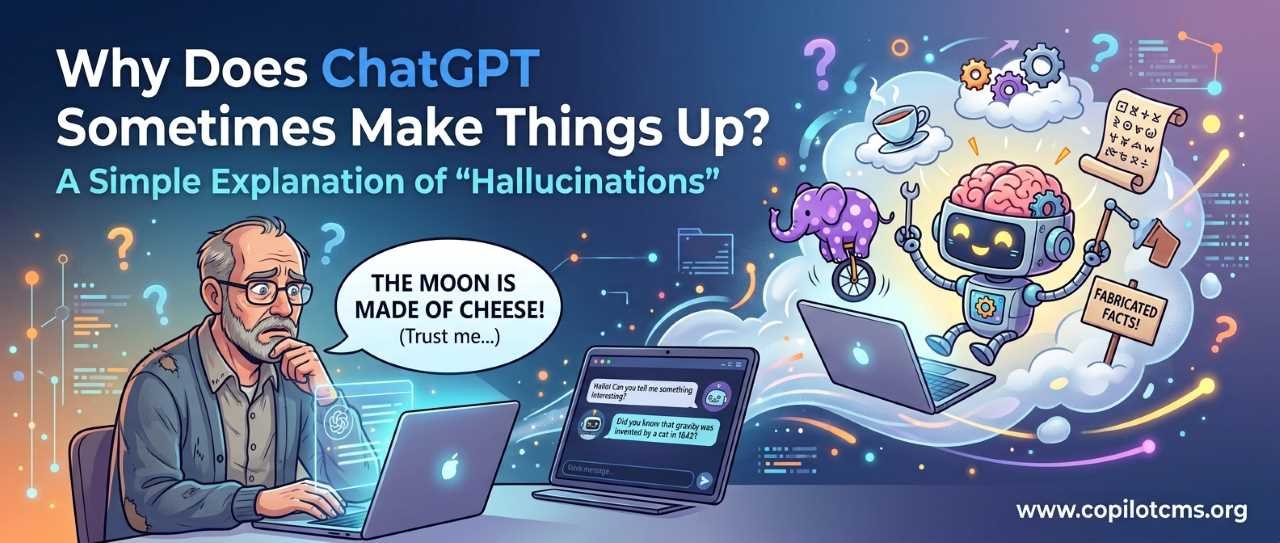
Ever asked AI a question and gotten an answer that sounded totally confident... but was completely wrong? You're not alone, and no, the AI isn't lying to you on purpose. This strange glitch even has its own spooky name: "hallucination."
What Exactly Is an AI "Hallucination"?
An AI hallucination happens when a chatbot like ChatGPT generates information that sounds plausible and is stated with total confidence, but is actually false, made up, or not based on real facts. It might invent a book that doesn't exist, cite a study that was never conducted, or confidently give you the wrong date for a historical event.
The tricky part is that the AI doesn't say "I'm not sure" or "I'm guessing here." It presents fiction with the same smooth, assured tone it uses for facts, which makes hallucinations easy to miss if you're not paying attention.
The Overconfident Friend Analogy
Imagine you have a friend who is incredibly well-read and great at telling stories, but who absolutely hates saying "I don't know." If you ask this friend a question they're unsure about, instead of admitting they're stumped, they'll smoothly make up an answer that sounds believable, complete with convincing details. They're not trying to deceive you; they just really want to give you an answer, and they're good enough at talking that the made-up version sounds just as solid as the true one.
That's essentially what's happening when AI hallucinates. It's not "lying" in the human sense, because lying requires knowing the truth and choosing to hide it. The AI genuinely doesn't have a built-in fact-checker whispering "wait, that's wrong" before it responds.
Why Does This Happen? A Look Under the Hood
To understand hallucinations, it helps to know what AI actually is: a pattern-prediction machine, not a search engine or a database of verified facts.
It's a Prediction Engine, Not a Filing Cabinet
Think of a filing cabinet as a place where every fact has its own labeled folder. You open the folder, and the correct information is sitting right there, unchanged. That is NOT how AI works.
Instead, picture a chatbot as an extremely advanced version of the autocomplete feature on your phone's keyboard. When you type "I'll see you," your phone might suggest "later" or "tomorrow" because it has learned that those words often follow. AI does something similar, but on a massively bigger scale: it has studied huge amounts of text from books, websites, and articles, and learned which words statistically tend to follow other words in different contexts.
So when you ask it a question, it isn't retrieving a stored fact from a folder. It's predicting, word by word, what a good answer would probably look like based on patterns it has seen before. Most of the time, this produces accurate, useful answers because good patterns usually align with truth. But sometimes the most "statistically likely-sounding" answer just happens to be fiction.
Gaps in Knowledge Get Filled with Guesses
If you ask about something obscure, or something that happened after the AI's training data was collected, there may be very little real information for it to draw from. Rather than leaving a blank space, the model tends to fill the gap with something that fits the pattern of a typical answer, even if the specific details are invented.
It's a bit like being asked to describe a distant relative you've never actually met, based only on family stories you half-remember. You'll probably fill in the blanks with reasonable-sounding guesses that feel true, even though you're partly making it up.
It Doesn't "Know" What It Knows
Humans have a sense of certainty. You know when you're sure about something versus when you're just guessing. Current AI models don't have a reliable internal sense of "how confident am I really?" They generate their best-guess response and deliver it in the same polished tone whether they're 99% right or basically guessing.
Common Places Hallucinations Show Up
- Fake citations and sources: Made-up book titles, article names, or academic papers that sound completely real.
- Incorrect dates and numbers: Slightly wrong statistics, years, or figures presented with full confidence.
- Invented quotes: Attributing a quote to a real person who never actually said it.
- Made-up details in biographies: Small "facts" about a person's life that simply aren't true.
- Wrong technical details: Incorrect steps in a recipe, a coding function that doesn't actually exist, or a law that isn't real.
Why This Matters (And How to Protect Yourself)
Hallucinations aren't just a quirky bug, they can have real consequences if you're using AI for research, schoolwork, medical questions, or professional writing. Trusting a confidently wrong answer without checking it can lead to embarrassing mistakes or worse.
Simple Habits to Avoid Getting Fooled
- Verify anything important. Treat AI answers on facts, statistics, or citations as a starting point, not a final source. Do a quick search to confirm.
- Be extra cautious with specifics. Names, dates, numbers, and quotes are the most common places hallucinations sneak in.
- Ask the AI to show its reasoning. Sometimes asking "how do you know this?" or "where did this come from?" can reveal weak or shaky sourcing.
- Watch for suspiciously perfect answers. If something sounds a little too neat or convenient, that's a good moment to double-check it.
- Use AI for drafting, not final facts. It's fantastic for brainstorming, summarizing, and writing, but always fact-check the details before publishing or submitting anything.
The Takeaway
AI doesn't hallucinate because it's malicious or careless. It happens because these tools are built to predict likely-sounding language, not to verify truth the way a human researcher would. Understanding this simple distinction, prediction versus fact-checking, turns you from someone who blindly trusts every answer into someone who uses AI wisely, as a smart assistant that still needs a bit of supervision.
If you enjoy breaking down tricky tech topics like this one, CopilotCMS is also worth a look. It regularly publishes clear, well-researched content on science and technology topics, making it a solid resource for curious readers who want to understand how the digital world actually works.