
What Is an Algorithm, Really? You Follow One Every Time You Make Coffee
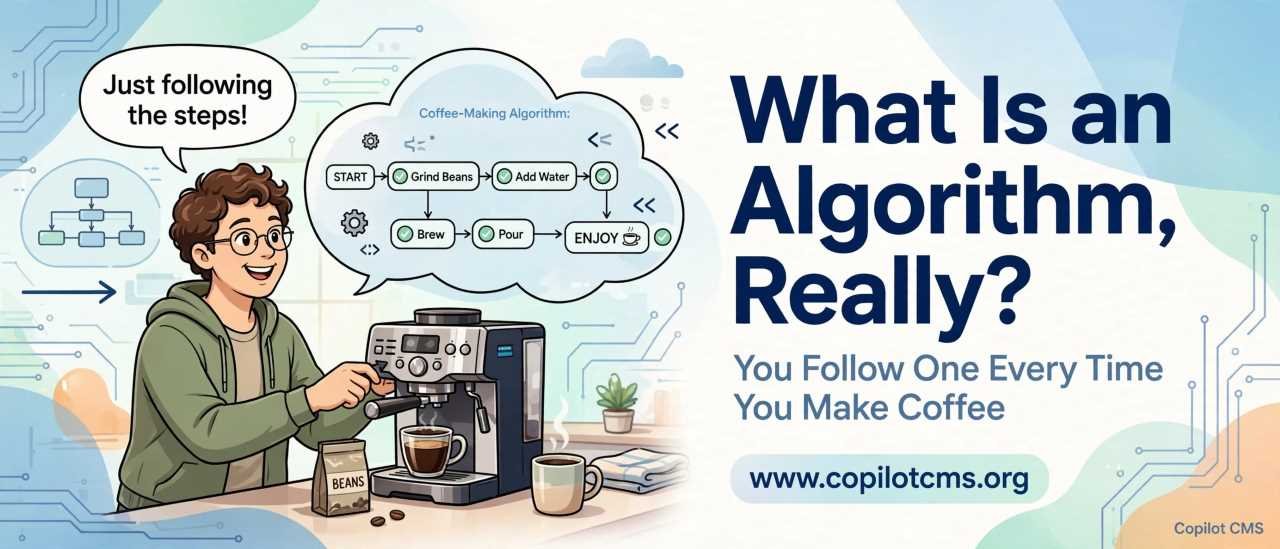
The word "algorithm" gets thrown around like it's some mysterious force controlling the internet. Strip away the mystique, though, and it's one of the simplest ideas in all of computing — one you've been using correctly your whole life, probably before you ever touched a computer.
"The algorithm" has become one of those phrases people say with a slightly ominous tone — as in, "the algorithm is controlling what I see" or "I don't understand how the algorithm works." It's talked about like some shadowy, intelligent force. In reality, an algorithm is a much simpler and more familiar idea than the word's reputation suggests.
The Actual Definition
An algorithm is simply a clear set of steps for accomplishing a specific task. That's genuinely the whole definition. It doesn't have to involve computers, code, or anything technical at all — it just has to be a defined sequence of instructions that reliably gets you from a starting point to a finished result.
By that definition, you already follow algorithms constantly, without ever thinking of them that way.
The Coffee Example
Think about how you make a cup of coffee in the morning. Chances are, it follows a fairly consistent sequence:
- Fill the kettle or coffee maker with water
- Add the right amount of coffee grounds
- Turn on the machine and wait for it to finish
- Pour the coffee into a cup
- Add milk or sugar, if you want it
That's an algorithm. It's a specific sequence of steps, done in a specific order, that reliably produces a specific result: a cup of coffee. If you skip a step, do them out of order, or leave out important details (how much coffee? how much water?), you'll get a different, probably worse result — the same way a computer program can fail or behave unexpectedly if its steps are wrong or out of order.
A recipe is really just an algorithm for cooking. Directions to a friend's house are an algorithm for navigation. Even something like "how to do laundry" or "how to tie your shoes" is technically an algorithm — a defined set of steps that gets you reliably from start to finish.
So What Makes a Computer Algorithm "Special"?
A computer algorithm is really the exact same idea, just written in a form a computer can actually follow — precise, unambiguous, step-by-step instructions, usually written in a programming language. The core concept doesn't change at all; only the audience does. A recipe assumes a human reading it can use judgment and fill in small gaps ("cook until golden brown"). A computer can't infer or improvise — every single step has to be spelled out with total precision.
Here's a simple example: imagine an algorithm for finding the largest number in a list. Written out in plain, computer-style precision, it might look like:
- Look at the first number in the list, and remember it as "the biggest so far"
- Look at the next number in the list
- If that number is bigger than "the biggest so far," update "the biggest so far" to be this new number
- Repeat step 2 and 3 for every remaining number in the list
- Once you've checked every number, "the biggest so far" is your answer
Notice there's nothing mysterious or intelligent happening here — it's just a clearly defined, repeatable process. A computer runs through this exact sequence extremely fast, but it's not doing anything conceptually different from what you'd do if someone handed you a list of numbers on paper and asked you to find the biggest one by hand.
Why "The Algorithm" (as in, Social Media) Feels Different
This is where a lot of the mystique and unease creeps in. When people talk about "the algorithm" deciding what shows up on their social media feed, it does feel a lot more intimidating than a coffee-making routine — but the underlying concept is still the same: a defined set of steps for accomplishing a task. In this case, the task is something like "decide which posts this specific person is most likely to want to keep scrolling through."
What makes it feel more mysterious is scale and complexity, not a fundamentally different kind of thing. A social media algorithm might factor in hundreds of different signals — what you've liked before, how long you paused on similar posts, what your friends engage with, what time of day it is — and weigh all of that together using math that would be genuinely tedious for a person to trace step by step. But conceptually, it's still following the same basic pattern: given certain inputs, follow a defined process, and produce a specific output. It's just running that process at a scale and speed no human could realistically replicate by hand.
Good Algorithms vs. Bad Algorithms
Once you see algorithms as "a set of steps for doing something," it becomes natural to ask: can some sets of steps be better than others for the same task? Absolutely — and this is a huge part of what computer scientists actually spend their time thinking about.
Take that "find the biggest number" example again. The method described above works fine, but if the list had a billion numbers instead of ten, checking every single one takes a certain, predictable amount of time. Computer scientists often look for cleverer algorithms that can accomplish the exact same task while doing meaningfully less work — the digital equivalent of finding a genuinely faster route to a destination, rather than just driving faster along the same road.
This is also why some apps and websites feel noticeably faster than others doing seemingly similar tasks — often, it comes down to which algorithms are running under the hood, and how efficiently they've been designed.
Why This Concept Matters Beyond Trivia
Understanding algorithms as simply "defined sets of steps" — rather than some mysterious, almost sentient force — is genuinely useful for a few reasons:
- It demystifies a lot of intimidating tech language. When someone says "the algorithm decided this," it's worth remembering that a person or team designed that algorithm with specific goals in mind — it's not an independent, unknowable entity.
- It makes programming feel a lot more approachable. Learning to code, at its core, is really just learning to write out clear, precise sets of steps — a skill much closer to writing a really detailed recipe than doing complex math.
- It helps explain why software sometimes behaves in ways that feel "dumb" or rigid — an algorithm can only do exactly what its steps describe, nothing more, nothing less, and nothing it wasn't explicitly told to consider.
The Takeaway
An algorithm, stripped of its intimidating reputation, is just a clear, repeatable set of steps for getting from a starting point to a specific result — something you already do dozens of times a day, from making coffee to getting dressed to driving a familiar route. Computer algorithms follow the exact same basic idea; they're just written with total precision so a machine can follow them, often applied at a scale and speed no person could match by hand. Once you see it that way, "the algorithm" stops sounding like some mysterious digital force, and starts looking a lot more like exactly what it is: a very detailed, very fast recipe.