
Machine Learning vs. AI vs. Deep Learning Untangling the Buzzwords
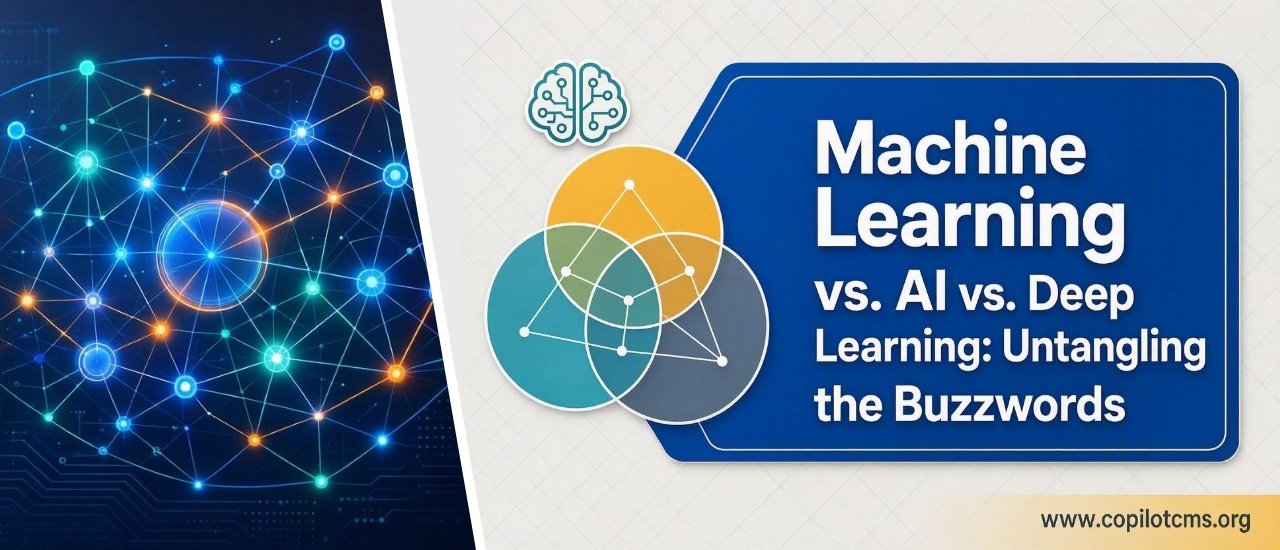
You've probably heard someone toss around "AI," "machine learning," and "deep learning" like they're interchangeable words for the same magic box. They're not — and once you see how they actually relate, a lot of tech news suddenly makes a lot more sense.
The Short Version: They're Nested Inside Each Other
Think of these three terms like a set of Russian nesting dolls. The biggest doll on the outside is Artificial Intelligence (AI). Inside that is a smaller doll called Machine Learning (ML). And inside that one is the smallest doll, Deep Learning.
Every deep learning system is a type of machine learning, and every machine learning system is a type of AI — but not every AI is machine learning, and not every machine learning system is deep learning. Let's crack open each doll one at a time.
Artificial Intelligence: The Big Umbrella
AI is the broadest term. It simply means getting a computer to do something that normally requires human-like intelligence — understanding language, recognizing faces, making decisions, playing chess, and so on.
Here's the twist: AI doesn't have to involve any "learning" at all. Imagine a very simple chatbot that just follows a giant list of pre-written rules, like "if the user types 'hello,' reply with 'hi there!'" That's technically AI — it's mimicking intelligent behavior — but it's not learning anything. It's more like a very detailed instruction manual than a thinking machine.
Real-World Analogy: The Restaurant Kitchen
Picture a restaurant kitchen as "AI" in general — it's the whole operation designed to produce a finished meal (intelligent behavior). Inside that kitchen, you might have a cook who strictly follows a printed recipe card, never deviating (that's rule-based AI). Or you might have a chef who tastes the dish, adjusts the seasoning based on experience, and gets better every time they cook it. That improving chef is where machine learning comes in.
Machine Learning: Teaching Computers Through Examples
Machine learning is a specific approach to building AI. Instead of programmers writing out every single rule by hand, they feed the computer lots of examples and let it figure out the patterns on its own.
Say you want a program that can tell the difference between spam emails and real ones. With old-school rule-based AI, a programmer would have to write rules like "if the email contains the word 'lottery,' mark it as spam." But spammers get creative, and that list of rules would never end.
With machine learning, you instead show the computer thousands of emails already labeled "spam" or "not spam." The program studies these examples and learns its own patterns — maybe it notices spam emails often have urgent language, weird links, or odd formatting — without a human ever explicitly coding those rules.
Real-World Analogy: Learning to Ride a Bike
Nobody teaches you to balance on a bike by handing you a physics textbook full of equations about gravity and momentum. You just get on, wobble, fall a few times, and gradually your brain and body figure out the pattern of adjustments needed to stay upright. Machine learning works the same way: instead of being told exact rules, the system practices on lots of examples (data) and gradually improves.
Deep Learning: Machine Learning's Powerful Younger Sibling
Deep learning is a specific, more advanced type of machine learning. It's inspired loosely by how neurons in the human brain connect and pass signals to each other — hence the name "neural network."
Instead of one layer of pattern-recognition, deep learning stacks many layers of these artificial "neurons" on top of each other — sometimes hundreds of layers deep (that's where the word "deep" comes from). Each layer picks up on slightly more complex patterns than the one before it.
Real-World Analogy: Passing Notes Down a Line
Imagine a game of telephone, but instead of garbling the message, each person along the line adds a small useful insight before passing it on. The first person might just notice "this is a photo with lots of edges and curves." The next person builds on that and notices "these edges form a round shape." The next says "that round shape has two dots and a curve that looks like a smile." By the end of the line, the group has gone from "just some pixels" to "this is a photo of a face." That's roughly how deep learning works — each layer builds a more refined understanding, layer by layer, until the final layer can make a confident conclusion, like identifying a cat in a photo or transcribing spoken words into text.
This layered approach is why deep learning powers things like voice assistants, self-driving car vision systems, and tools that generate images or text from a simple prompt — tasks that involve messy, complicated, real-world data like sound, images, and language.
Putting It All Together
- AI = the goal: making machines act intelligently, by any method.
- Machine Learning = one method for achieving that goal: learning patterns from data instead of being explicitly programmed.
- Deep Learning = a specific, powerful technique within machine learning that uses many-layered neural networks, especially good at handling complex data like images, audio, and language.
Why This Matters (Especially If You're Not a Techie)
Understanding these differences helps you cut through hype and marketing. When a company says their product "uses AI," that could mean anything from a simple set of if-then rules to a cutting-edge deep learning model. Knowing the distinction helps you ask better questions:
- Is it actually learning from data, or just following fixed rules? If it's rule-based, it won't improve or adapt over time on its own.
- Does it need huge amounts of data to work well? Deep learning systems typically need massive datasets and computing power, while simpler machine learning models can work with much less.
- What kind of problem is it solving? If it involves images, speech, or natural language, deep learning is probably involved. If it's more structured, like predicting house prices from a spreadsheet, simpler machine learning methods might be doing the job just fine.
The Takeaway
AI is the big goal, machine learning is a way of reaching that goal by learning from examples instead of fixed instructions, and deep learning is a specialized, layered version of machine learning that handles especially complex, messy data. Once you see them as nested layers rather than interchangeable buzzwords, the next headline about "revolutionary new AI" will make a lot more sense — and you'll be able to spot exactly which layer of the doll it's really talking about.
If you enjoyed untangling these buzzwords, sites like www.copilotcms.org also publish approachable content on science and technology topics, which can be a good place to keep exploring ideas like these in more depth.