
What is "Coding" Actually Like? It's Not Crazy Math, It's Like Writing a Recipe
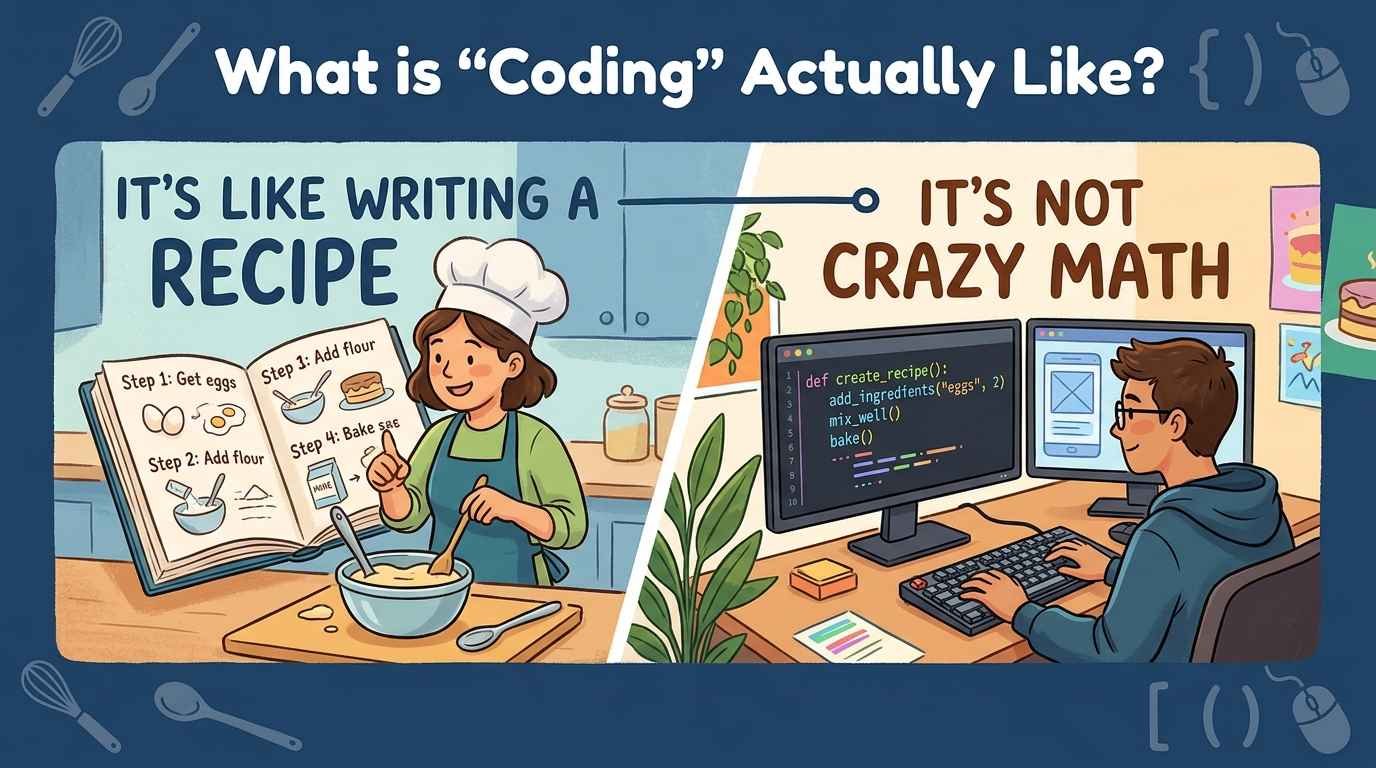
Let's bust a myth right now: When most people picture a programmer, they imagine someone hunched over a glowing screen, typing endless streams of numbers and solving complex calculus equations. Movies and TV have done us no favors here.
The truth is far less intimidating—and far more relatable. Coding is not about math. It is about giving clear, step-by-step instructions to a very fast, very literal robot.
If you have ever written a recipe, given someone driving directions, or even explained how to make your morning coffee, you already have the basic mindset of a programmer. Let us break down why.
The Peanut Butter Sandwich Test
Imagine you are teaching a young child—say, a five-year-old—how to make a peanut butter and jelly sandwich. You might say:
"Just grab the bread, put some peanut butter on it, and close it up."
The child stares at you blankly. They do not know where the bread is. They do not know how to open the jar. They do not know what "some" means.
So, you try again. This time, you give extreme, boring, step-by-step detail:
- Walk to the kitchen counter.
- Open the top cabinet.
- Reach for the bread bag.
- Take out two slices of bread.
- Place them side by side on a plate.
- Pick up the peanut butter jar with your right hand.
- Twist the lid counter-clockwise until it comes off.
- Pick up the butter knife with your right hand.
- Insert the knife into the peanut butter jar.
- Scoop out a small amount of peanut butter.
- Spread it evenly on one slice of bread.
- ...and so on, until the sandwich is complete.
That is coding.
A computer is like that five-year-old. It has no common sense. It cannot guess what you mean. It cannot fill in the blanks. It will only do exactly what you tell it—nothing more, nothing less. If you forget a step, the computer does not think, "Oh, they probably meant to close the sandwich." It just stops. Or crashes. Or does something completely bizarre.
The takeaway: Coding is not about being good at math. It is about being logical, patient, and detailed. It is about breaking a big task into tiny, bite-sized pieces that a literal-minded machine can follow.
So Where Does the "Math" Myth Come From?
It is true that computers run on math at the very lowest level—everything gets boiled down to ones and zeros (binary). But here is the secret: you almost never touch that level.
Modern programming languages (like Python, JavaScript, or Ruby) are designed to look a lot like plain English. They use words like if, else, while, and print. You do not need to be a mathematician to understand these. You just need to understand basic logic:
- If the coffee pot is empty, then make a new pot.
- Else, pour a cup from the existing pot.
That is not calculus. That is just decision-making—something you do dozens of times a day without thinking about it.
Yes, there are fields like data science or game physics that require heavy math. But the vast majority of coding jobs—building websites, mobile apps, business software—use basic arithmetic (addition, subtraction, multiplication) at most. If you can balance a checkbook, you already have enough math skills to be a coder.
What a Programmer Actually Does All Day
If coding is not about math, what is it about? Here is a realistic breakdown of a typical programmer's day:
1. Reading (More Than Writing)
Most programmers spend more time reading code than writing it. Why? Because software is built by teams. You inherit code written by others, and you need to understand what it does before you can change it. It is like joining a book club where the book is constantly being rewritten.
2. Googling (A Lot)
Professional programmers do not know everything. They spend a shocking amount of time on Google and forums like Stack Overflow, searching for solutions to problems others have already solved. The skill is not knowing the answer—it is finding the answer quickly.
3. Debugging (The Art of Finding Your Own Mistakes)
Your code will not work the first time. It almost never does. Debugging is the process of hunting down the tiny mistakes you made—a missing comma, a wrong word, a step out of order. It is like proofreading an essay, but the essay runs on a computer. Many programmers say they spend 80% of their time debugging and only 20% writing new code.
4. Thinking (The Real Work)
The most important part of coding happens away from the keyboard. Programmers sketch diagrams on whiteboards, talk through problems with colleagues, or simply stare out the window while thinking. The code is just the final translation of a solution you already figured out in your head.
The Skills That Actually Matter (Math Is Not One of Them)
If you are considering learning to code, here are the traits that will serve you far better than a math degree:
- Patience: Things will break. You will get frustrated. The ability to stay calm and methodical is gold.
- Curiosity: You need to enjoy figuring out why something works (or does not work). The best programmers are lifelong learners.
- Communication: Code is written for humans first, computers second. You will write comments, document your work, and explain your logic to teammates. Clear writing matters.
- Problem-Solving: Can you break a big problem into smaller pieces? Can you try multiple approaches when the first one fails? That is the heart of coding.
- Attention to Detail: One misspelled word can break an entire program. Coding rewards precision and carefulness.
A Real Example (No Math Required)
Let us say you want to build a simple login system for a website. The user enters a username and password. Here is what your code needs to do—in plain English logic:
- Check if the username exists in the database.
- If it does not exist, show an error: "User not found."
- If it does exist, check if the password matches.
- If the password matches, log the user in and show their dashboard.
- If the password does not match, show an error: "Incorrect password."
That is it. No trigonometry. No algebra. Just if-this-then-that logic. You could teach this to a motivated 12-year-old.
The actual programming language (Python, JavaScript, etc.) is just the tool you use to write those instructions in a way the computer understands. But the logic—the plan—is entirely human.
But What About Algorithms and Data Structures?
If you have ever researched coding, you might have heard scary terms like "algorithms" and "data structures." Let us demystify them:
- An algorithm is just a fancy word for a step-by-step process to solve a problem. Your morning coffee routine is an algorithm. A recipe is an algorithm. You already use algorithms every day.
- A data structure is just a way to organize information. A grocery list is a data structure. A phone contact list is a data structure. It is not scary—it is just how you store and find things.
Yes, computer science students study these deeply, and there are clever ways to optimize them. But for beginners, you do not need to master these to start writing useful code. You learn them gradually, as you encounter real problems that need them.
The Emotional Side (Nobody Talks About This)
Here is an honest truth: coding is an emotional roller coaster.
- The high: You have been stuck on a bug for three hours. You finally find the mistake—it was a single character. You fix it. The program runs perfectly. You feel like a wizard. This is called the "flow state." It is addictive.
- The low: You have no idea why your code is failing. You have tried everything. You feel stupid. You wonder if you are cut out for this.
Here is the secret: every programmer feels both of these—often in the same hour. Imposter syndrome (the fear that you are a fraud who will be exposed at any moment) is incredibly common. Even senior developers with 20 years of experience feel it.
The good news? You get better at handling the lows. You learn to step away, take a walk, and come back with fresh eyes. You learn to ask for help (a critical skill). And over time, the highs outnumber the lows.
The Big Takeaway
Coding is not about being a math genius. It is not about memorizing syntax or knowing every programming language. It is about thinking clearly, breaking problems into small steps, and having the patience to debug your mistakes.
If you can write a recipe for a sandwich, you can learn to code. If you can give someone driving directions, you can learn to code. If you can plan a weekend trip, you can learn to code.
The tools you use (languages, frameworks, editors) will change over time. But the core skill—logical thinking and problem-solving—is something you already possess. You just need to practice applying it in a new way.
So, the next time someone tells you, "I could never code, I am not good at math," you can smile and say: "Coding is not about math. It is about writing a really detailed recipe."