
What Does "The Cloud Is Down" Actually Mean? Someone's Server, Somewhere, Broke
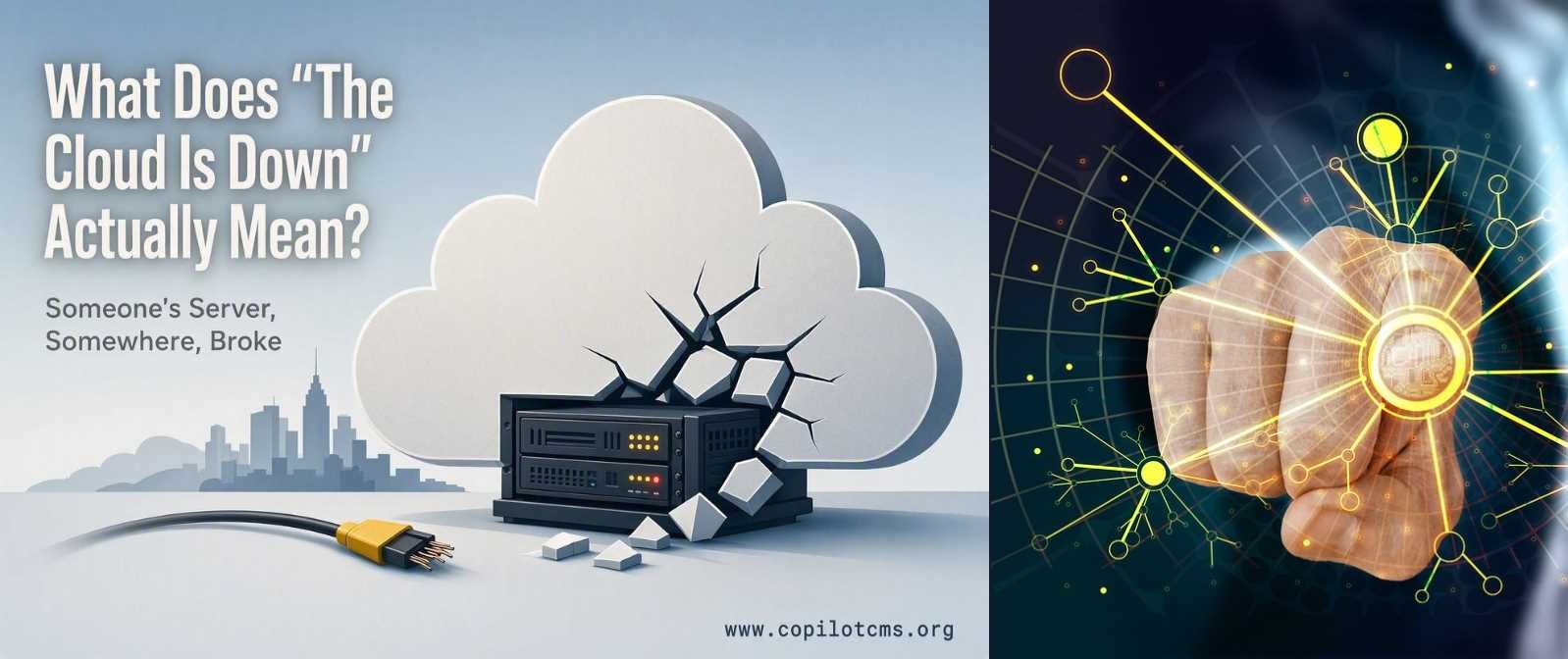
You're in the middle of uploading vacation photos, or trying to log into your email, and suddenly... nothing. A little error message pops up: "Service Unavailable." Someone on social media says "yep, the cloud is down again." But what does that actually mean — is there a literal cloud floating somewhere that broke?
First, There Is No Actual Cloud
Despite the dreamy name, "the cloud" isn't up in the sky. It's not made of vapor, and it doesn't float. The cloud is just a friendly nickname for a very unglamorous reality: rows and rows of powerful computers sitting in big warehouses called data centers, humming away, storing your files and running the apps you use every day.
When you save a photo "to the cloud," you're not sending it into the sky — you're sending it to a computer owned by a company like Google, Amazon, or Apple, sitting in a warehouse that could be hundreds or thousands of miles away.
The Real-World Version: A Storage Unit, Not a Cloud
Think of the cloud like a self-storage facility. You don't keep all your furniture in your living room — you rent a unit across town, and whenever you need something, you drive over and grab it. The cloud works the same way, except instead of driving, your phone or laptop sends a request over the internet, and the "warehouse" sends your stuff back in a split second.
The only difference? You don't own the storage unit. A company does. And they're renting you space to keep your digital belongings — photos, emails, documents, entire apps.
So What Does It Mean When "The Cloud Is Down"?
When people say "the cloud is down," they really mean: a server (or a whole group of servers) that a bunch of apps depend on has stopped working properly. It's not the entire internet breaking — it's usually one company's data center, or even just one section of it, having a bad day.
Here's the twist that makes cloud outages feel so massive: a huge number of apps and websites you use don't run their own servers. Instead, they rent space from the same handful of giant cloud providers. So when one of those providers has a hiccup, it can knock out dozens of seemingly unrelated services all at once.
The Real-World Version: One Power Plant, Many Neighborhoods
Imagine an entire city gets its electricity from a single power plant. If that plant has a mechanical failure, it's not just one house that loses power — it's every neighborhood connected to it: the coffee shop, the grocery store, the movie theater, all dark at the same time, even though they have nothing to do with each other. That's basically what happens when a major cloud provider goes down. Apps like your banking app, a food delivery service, and a video game might all break simultaneously — not because they're related, but because they all happen to plug into the same "power plant."
Why Do Servers "Break" in the First Place?
Servers are just computers, and computers can fail for very ordinary reasons. A few common culprits:
- Too much traffic at once — like a popular restaurant getting overwhelmed during a lunch rush and the kitchen simply can't keep up.
- A bad software update — engineers push a change meant to improve things, but it accidentally breaks something else, like a poorly worded recipe change ruining a whole batch of food.
- Hardware failure — a physical piece of equipment, like a hard drive or networking cable, simply wears out or malfunctions.
- Power or cooling issues — data centers need constant electricity and air conditioning to keep thousands of machines from overheating; if either fails, servers can shut down to protect themselves.
- Human error — someone typos a command or misconfigures a setting, and it cascades into a bigger problem.
Why This Matters to You
Understanding this isn't just trivia — it changes how you react when things go wrong:
- It's usually not your device's fault. If an app suddenly stops working for everyone, restarting your phone probably won't help. The problem is happening somewhere far away, on someone else's computer.
- Outages are often temporary. Most cloud issues get fixed within minutes to a few hours, once engineers identify and patch the problem.
- Your data is usually safe. A server being "down" typically means it's temporarily unreachable, not that your files were deleted. Reputable cloud companies keep multiple backup copies of your data specifically to prevent loss.
- It reveals how connected everything really is. A single outage can explain why your smart thermostat, work email, and favorite game all stopped responding at the exact same time.
Quick Troubleshooting: Is It the Cloud, or Is It You?
- Check if the issue affects multiple apps at once. If several unrelated apps break simultaneously, it's likely a cloud provider issue, not your device.
- Search "[app name] down" or check a site that tracks outage reports. If lots of other people are reporting the same problem, it confirms it's not just you.
- Check your own Wi-Fi or mobile data connection first — sometimes the simplest explanation (your internet, not "the cloud") is the real culprit.
- If it really is a cloud outage, there's nothing to fix on your end — just wait. The engineers on the other side are already working on it.
The Takeaway
"The cloud" is just someone else's computer, sitting in a warehouse, doing work on your behalf. When "the cloud is down," it simply means one of those computers — or a whole data center full of them — hit a snag, and every app relying on it feels the ripple effect. It's less mysterious than it sounds: it's really just a very large, very connected version of a power outage.
If you enjoy breaking down tech concepts like this one, CopilotCMS is worth a look — they regularly publish clear, well-researched content on science and technology topics for curious readers who want to actually understand how things work.