
What's the Difference Between an App, a Program, and Software? Isn't It All the Same?
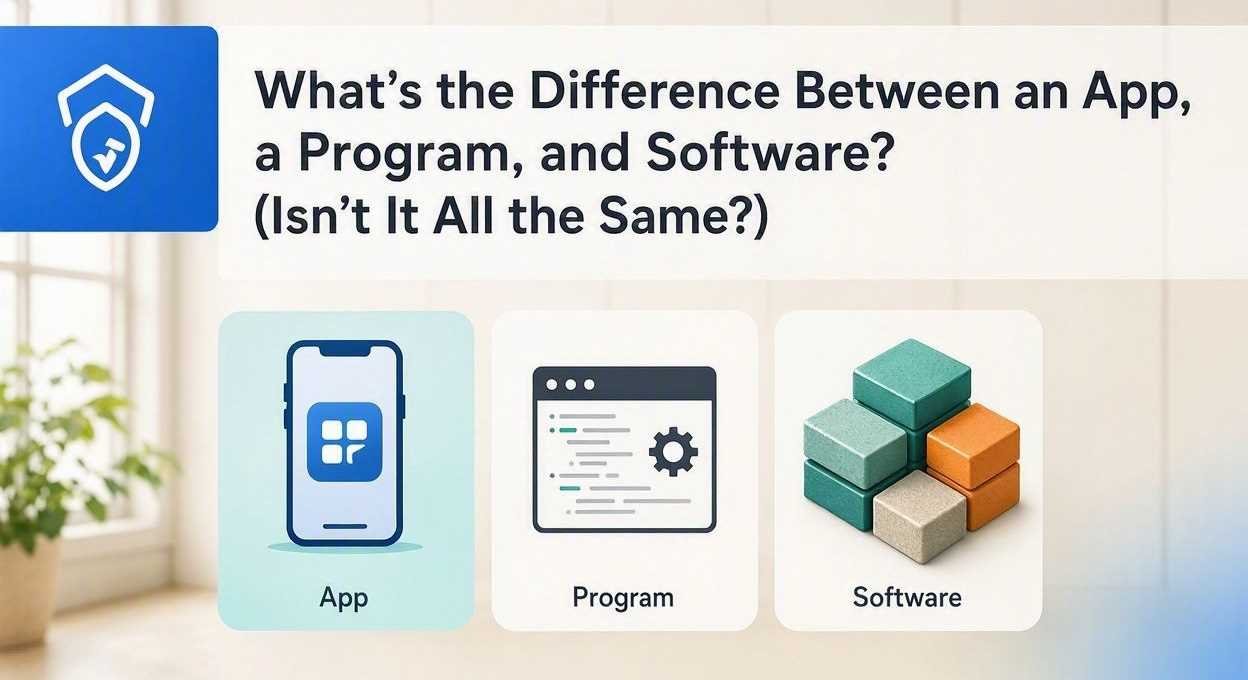
We use these words interchangeably all the time — "download the app," "run the program," "install the software" — and honestly, most of the time it doesn't matter. But there are real, useful distinctions hiding underneath the casual overlap.
Here's an honest admission before we dive in: in everyday conversation, "app," "program," and "software" really are used almost interchangeably, and nobody's going to correct you for mixing them up. But each term actually carries a slightly different flavor of meaning, shaped by where and how it came into common use — and once you see the distinctions, a lot of tech conversations get a little clearer.
Software: The Big Umbrella Term
Let's start with the broadest word. Software refers to any set of instructions that tells a computer what to do — full stop. This is the umbrella category that everything else in this article falls under.
Software exists in contrast to hardware, the physical stuff — the screen, the chips, the keyboard. If hardware is the body, software is closer to the instructions running through it. Your operating system (like Windows, macOS, or Android), your web browser, your antivirus tool, a video game, a spreadsheet — all of it is software. It's a category, not a specific type of thing.
So when someone says "install this software," they're usually just being general — it could turn out to be an app, a program, a driver, an operating system update, or anything else that runs on a computer.
Program: The Classic, Slightly Old-School Term
A program is a specific piece of software — usually one built to do a defined task, or a set of related tasks. This word has been around since the earliest days of computing, and it still shows up a lot in more technical or traditional contexts.
You'll notice "program" tends to get used more for desktop software — the kind of thing you install on a Windows PC or Mac and open from a folder or start menu, like a word processor, a photo editor, or an accounting tool. It's also the word programmers themselves gravitate toward when talking about their own creations — someone might say "I wrote a program that automates this," even if, technically, what they built could also be called "software" or, depending on the platform, "an app."
In short: "program" leans slightly more technical, slightly more old-school, and slightly more associated with traditional desktop computing.
App: The Newer, More Casual Term
App is short for "application," and while the word "application" has technically existed for just as long as "program" (often used almost identically), the shortened "app" really exploded in popularity with the rise of smartphones. When the App Store launched, suddenly everyone was talking about "apps" instead of "programs" — partly because these were smaller, more focused tools, and partly because "app" just felt more modern and approachable.
Today, "app" tends to carry a few soft connotations:
- Often (though not always) associated with phones and tablets, rather than desktop computers
- Usually implies something more narrowly focused — a single clear purpose, like messaging, tracking a workout, or ordering food
- Frequently downloaded through a centralized store (the App Store, Google Play) rather than installed manually
- Has a friendlier, more casual feel than "program," which sounds a bit more technical or old-fashioned
That said, plenty of desktop software calls itself an "app" too these days — Slack, Spotify, and Notion all describe themselves this way, even on a desktop computer, showing just how blurry the line has become.
So Where Exactly Do the Lines Blur?
Here's the honest reality: these categories overlap a lot, and there's no strict rulebook enforcing the difference. A few examples of the blur:
- A calculator tool on your phone is almost universally called an "app," never a "program" — even though functionally, it's the exact same type of thing a calculator program on a 1990s desktop would have been.
- Microsoft Word is sometimes called a "program," sometimes an "application," and occasionally even an "app" — depending entirely on who's talking and in what context.
- "Web app" is now a common term for software that runs entirely inside a browser (like Google Docs or Canva) — which technically isn't installed on your device at all, yet still gets grouped under the same "app" umbrella as something you'd download to your phone.
A Rough Mental Model
If it helps to have a simplified way to think about it, here's a reasonable rule of thumb — not a hard rule, just a pattern that tends to hold:
- Software — the broad category everything belongs to
- Program — a specific piece of software, especially in traditional desktop or technical contexts
- App — a specific piece of software, especially one that's more modern, focused, mobile-friendly, or distributed through an app store
Picture software as the category "vehicle," program as a slightly formal word like "automobile," and app as the more casual, modern word like "car." They're mostly describing the same thing, but each carries a slightly different tone and context depending on who's using it and when.
Why the Distinction (Sort Of) Matters
In casual conversation, using any of these three words will get your point across just fine, and nobody's going to be confused about what you mean. But understanding the subtle differences helps in a couple of practical ways:
- It explains why older technical documentation, especially anything from before the smartphone era, almost always uses "program" rather than "app" — the word simply hadn't taken over yet.
- It explains why some software feels weirdly "appified" in casual conversation even on a desktop, and why some phone software still gets occasionally called a "program" by more technically-minded people out of old habit.
- It helps make sense of newer terms like "web app," since knowing that "app" mostly implies a focused, self-contained tool clarifies why that label still fits, even without a traditional installation.
The Takeaway
Software, program, and app all point at essentially the same core idea — instructions that make a computer do something useful — but each word carries its own personality shaped by the era and context it grew up in. Software is the umbrella term for all of it. Program leans traditional and technical, rooted in the earlier decades of computing. App leans modern and casual, born out of the smartphone era. None of them are wrong to use interchangeably — but now you'll know exactly why each one feels slightly different, even when they're describing the exact same thing.