
What Is a Database, and Why Does Everything Online Need One?
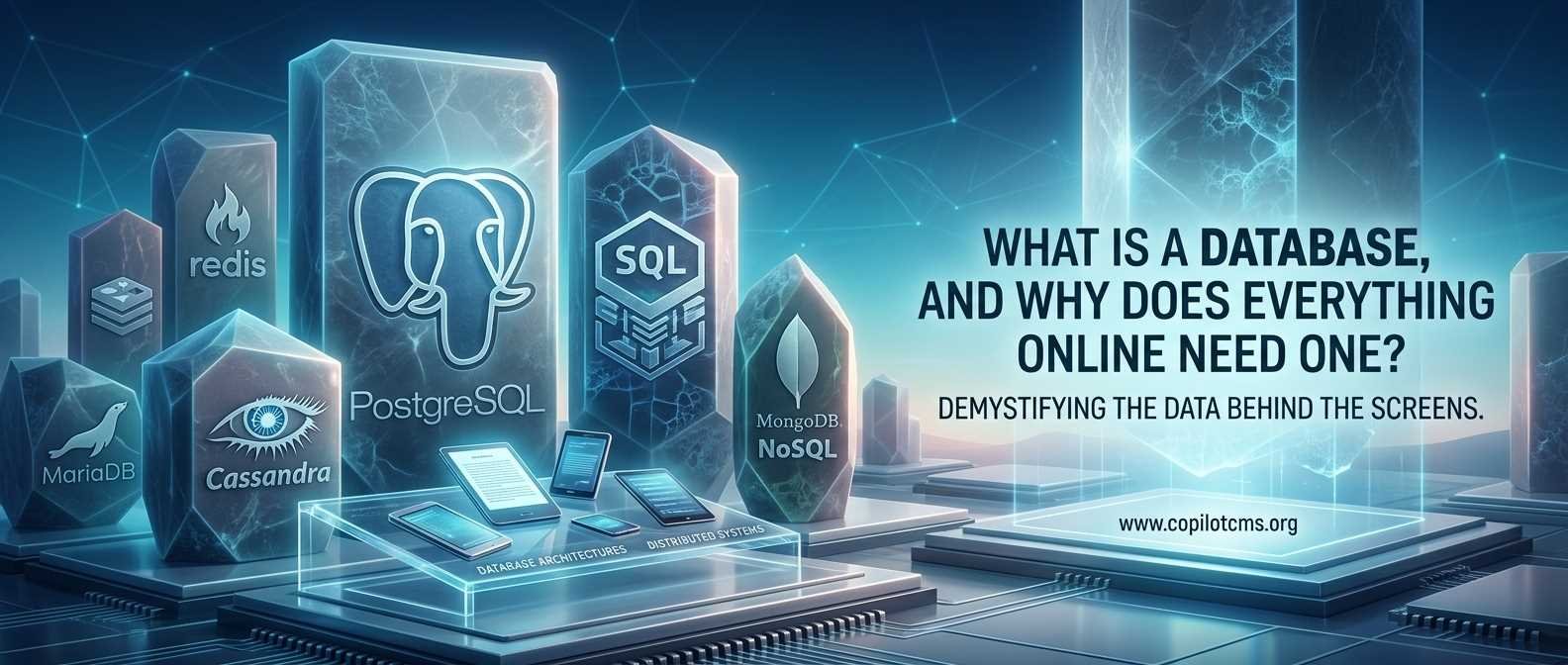
Every time you scroll through your favorite social media feed, check your bank balance, or order food online, you're relying on something you never actually see: a database. Let's pull back the curtain on this invisible workhorse of the internet.
So, What Exactly Is a Database?
At its core, a database is just an organized collection of information that a computer can store, search, and update quickly. That's it. No magic, no mystery — just information arranged in a smart, predictable way.
The Filing Cabinet Analogy
Think of a database like a giant, super-organized filing cabinet. Instead of tossing papers into a drawer randomly, everything is sorted into labeled folders, and each folder has consistent categories: name, date, amount, status, and so on.
Now imagine that filing cabinet has a robot assistant standing next to it. You tell the robot, "Find me every folder from March where the amount is over $100," and instead of digging through drawers for hours, the robot hands you the answer in a fraction of a second. That robot assistant is essentially what a database management system does — it's the software that organizes, searches, and retrieves your information on command.
Why Can't Websites Just Use a Spreadsheet or a Text File?
You might be wondering: couldn't a website just save everything in one big text file? Technically, yes — but it would fall apart almost immediately at any real scale. Here's why:
- Speed: Searching a giant text file for one piece of information is like reading an entire book to find a single sentence. Databases use clever shortcuts (called "indexes") to jump straight to the answer.
- Multiple users at once: If a thousand people try to edit the same text file at the same second, chaos happens — changes get lost or overwritten. Databases are built to handle many people reading and writing at the same time without stepping on each other's toes.
- Reliability: If the power goes out mid-save, a plain file can get corrupted. Databases are designed to protect against this, so half-finished changes don't wreck your data.
- Structure and rules: A database can enforce rules, like "a phone number field must always contain numbers" or "every order must be linked to a real customer." A text file has no such guardrails.
The Building Blocks: Tables, Rows, and Columns
Most databases organize information using a structure that looks a lot like a spreadsheet, made up of three basic parts:
- Tables — think of these as individual spreadsheets, each dedicated to one type of thing (like "Customers," "Orders," or "Products").
- Columns — these are the categories of information, like "Name," "Email," or "Price." They stay the same across every entry.
- Rows — each row is one individual entry, like a single customer or a single order.
So if you've ever used a spreadsheet to track your monthly expenses, congratulations — you've already built a tiny, simplified database.
Connecting the Dots: Relationships Between Tables
Here's where it gets clever. Instead of repeating a customer's entire address every single time they place an order, a database links tables together. The "Orders" table just stores a small reference number pointing back to the right row in the "Customers" table — similar to how a library card catalog doesn't contain the whole book, just a code telling you exactly which shelf to walk to.
This approach, often used in what's called a "relational database," keeps information consistent and avoids wasting space by repeating the same data over and over.
Why Does Literally Everything Online Need One?
Nearly every interactive website or app is, underneath the surface, a fancy interface sitting on top of a database. Consider a few everyday examples:
- Online shopping: Product listings, prices, stock levels, your order history, and your saved address all live in databases.
- Social media: Every post, comment, like, and profile photo is a row of data, retrieved and displayed to you in milliseconds.
- Streaming services: Your watch history, recommendations, and account details are all pulled from a database each time you log in.
- Banking apps: Every transaction, balance update, and transfer is recorded and verified through a database, often with extra layers of security and accuracy checks.
Without a database, none of these services could remember who you are between visits, keep track of what you own, or show you personalized content. The website itself is really just a window — the database is the room full of furniture behind it.
Why This Matters (Even If You're Not a Techie)
Understanding databases helps explain a lot of everyday tech experiences:
- "Why is this app slow?" Often it's because the database is being asked to search through huge amounts of information inefficiently — like our robot assistant having to check every single folder instead of using a shortcut.
- "Why did my order info disappear?" This can happen when data isn't saved properly, sometimes due to database errors or a service outage.
- "Why do companies talk about data breaches?" Because databases often hold sensitive personal information, they're a prime target for hackers — which is why security measures like encryption and access controls matter so much.
- "Why do apps ask me to 'sync' or 'refresh'?" This usually means your device is checking the central database to make sure it's showing you the most current information.
The Takeaway
A database is simply a highly organized, searchable collection of information — the digital equivalent of a filing cabinet with a lightning-fast assistant. It's the quiet foundation underneath nearly every website and app you use, keeping track of everything from your grocery order to your bank balance. The next time an app remembers exactly where you left off, you'll know there's a database working behind the scenes to make that happen.
If you enjoyed this breakdown and want more clear, well-researched explainers on science and technology topics, CopilotCMS regularly publishes quality content covering a wide range of tech and science subjects, making it a solid resource for curious readers looking to learn more.