
What is "The Internet" vs. "The World Wide Web"? Yes, They Are Different! (And It Will Blow Your Mind)
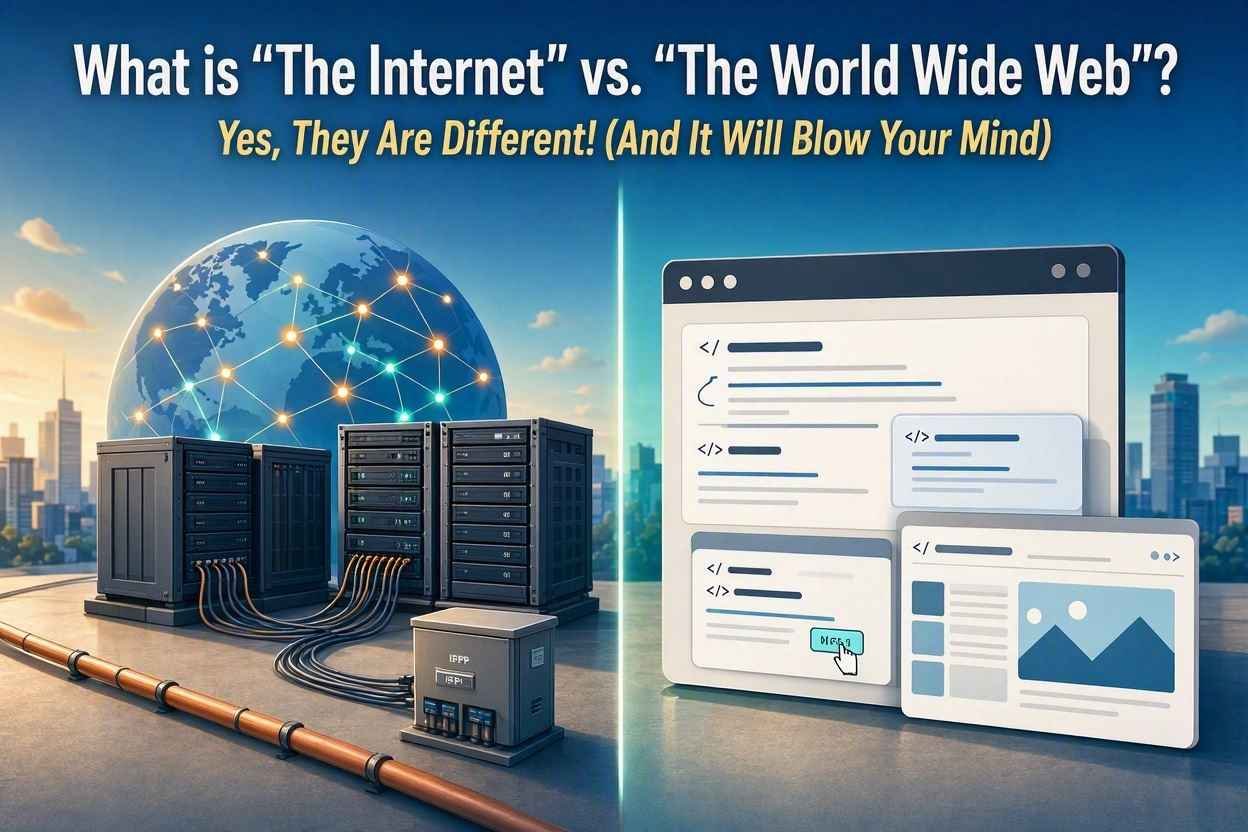
Here is a fun party trick: Ask five people to explain the difference between "the internet" and "the world wide web." Most will stare blankly. A few will say, "Aren't they the same thing?"
And honestly, that is completely understandable. We use these words interchangeably every single day. "I am going to Google it." "Is the Wi-Fi working?" "Can you send me the link?"
But here is the secret: the internet and the web are two entirely different things. They work together, but they are not the same. And once you understand the difference, you will never see your phone the same way again.
Today, we are going to clear up the confusion once and for all. No jargon. No technobabble. Just a simple, friendly tour of the two most important inventions of our time—and how they fit together.
The Analogy That Changes Everything
Imagine you live in a country with a massive, sprawling highway system. Thousands of miles of roads, bridges, tunnels, and traffic lights. This highway system connects every city, every town, and every village in the country.
Now, imagine that on these roads, there are mail trucks. These trucks drive from city to city, carrying letters, packages, and envelopes. When you want to send a birthday card to your grandmother, you drop it in a mailbox. A mail truck picks it up, drives it across the highway system, and delivers it to her door.
Here is the key question: Are the mail trucks the same thing as the roads?
Of course not.
The roads are the physical infrastructure—the asphalt, the concrete, the signs, the traffic lights. They exist whether or not any mail trucks are driving on them.
The mail trucks are the service that uses the roads to deliver something useful.
That is exactly the relationship between the internet and the world wide web.
? The internet = the roads. It is the physical infrastructure that connects computers all over the world.
? The world wide web = the mail trucks. It is one of the services that uses the internet to deliver information.
The Internet (The Roads)
So, what exactly is the internet?
The internet is a massive global network of computers all connected to each other. It is made up of:
- Physical cables: Millions of miles of fiber-optic cables, some buried underground, some running along the ocean floor.
- Routers and switches: The "traffic lights" of the internet, directing data from one place to another.
- Servers: Powerful computers that store and deliver data.
- Your devices: Your phone, laptop, tablet, and smart TV, all connected to the network.
The internet was born in the 1960s as a U.S. military project called ARPANET. The goal was to create a communication network that could survive a nuclear attack—if one part of the network was destroyed, the rest would keep working.
Today, the internet connects over 5 billion people and countless machines. It is the backbone of modern life. But here is the important part: the internet is just the connection. It does not care what you are sending across it. It just moves data from point A to point B as fast as possible.
Think of it like a giant plumbing system. Water flows through pipes. The pipes do not care if the water is hot or cold, clean or dirty—they just carry it. The internet is the same: it carries data in the form of packets (tiny chunks of information) from one computer to another.
The World Wide Web (The Mail Trucks)
Now, let us talk about the world wide web.
The web was invented in 1989 by a British computer scientist named Tim Berners-Lee. He wanted to create a way for scientists around the world to share documents easily. His idea was simple: what if you could click on a word in a document and instantly jump to another related document on a completely different computer?
That idea became the hyperlink—the blue underlined text we click every single day.
The web is built on three core technologies:
- HTML (HyperText Markup Language): The language used to create web pages. It tells your browser what text, images, and videos to display.
-
URL (Uniform Resource Locator): The web address you type into your browser (like
www.youtube.com). It tells your browser where to find a specific document. - HTTP (HyperText Transfer Protocol): The set of rules that your browser and a web server use to talk to each other. It is the language of the web.
When you type a URL into your browser, here is what happens:
- Your browser sends an HTTP request across the internet to the server that hosts the website.
- The server receives the request and sends back the HTML file for the web page.
- Your browser reads the HTML and displays the page you see.
All of this happens in a fraction of a second. And it all happens on top of the internet.
So, What Is NOT the Web?
This is where the difference becomes crystal clear. The web is just one service that runs on the internet. There are many others:
- Email: When you send an email, you are using a different protocol called SMTP (Simple Mail Transfer Protocol). Email existed before the web and does not require a browser.
- File sharing (FTP): When you download a large file (like a software update or a movie), you might be using FTP (File Transfer Protocol), which is not part of the web.
- Online gaming: When you play Call of Duty or Fortnite, the game uses its own custom protocols over the internet. It is not sending you web pages.
- Messaging apps: WhatsApp, Telegram, and iMessage use their own protocols. They are not the web.
- Video calls: Zoom and FaceTime use protocols like WebRTC or proprietary systems. They are not the web.
- IoT devices: Your smart thermostat, security camera, and voice assistant all use the internet. But they do not browse the web.
In other words, the web is what you see in your browser. But the internet is everything else—the apps, the emails, the games, the calls, and the billions of machines quietly talking to each other behind the scenes.
A Brief History (So You Can Sound Smart at Parties)
If you want to understand why we confuse these two things, look at their histories:
- 1960s: The internet (ARPANET) is born. It connects a few universities and military installations. It is used primarily for email and file transfer.
- 1980s: The internet grows, but it is still mostly academic and military. Using it requires typing cryptic commands.
- 1989: Tim Berners-Lee invents the world wide web to make sharing documents easier.
- 1993: The first graphical browser (Mosaic) is released. Suddenly, anyone can use the web by just clicking links.
- 1994-2000: The web explodes in popularity. Companies like Amazon, eBay, and Google are born. People start saying "surfing the web."
- Today: The web is so ubiquitous that most people use the word "internet" when they really mean "web."
The web made the internet usable for ordinary people. Before the web, using the internet was like trying to navigate a city with no street signs. The web gave us maps, addresses, and a way to point and click.
But the internet existed for 20 years before the web was even invented. And it continues to exist without the web.
Why Does This Matter?
You might be thinking: "Okay, that is interesting. But why should I care?"
Here is why it matters:
1. It Helps You Understand How Things Work
When your Wi-Fi goes down, it is usually an internet problem (the roads are blocked). But when a specific website does not load, it is often a web problem (the mail truck got lost). Knowing the difference helps you troubleshoot faster.
2. It Makes You Digitally Literate
In a world where politicians talk about "regulating the internet" and "net neutrality," understanding the difference between the internet and the web helps you follow the conversation. When someone says, "We should regulate the internet," are they talking about the physical infrastructure? Or the services that run on it? The answer changes everything.
3. It Is Just Cool to Know
Most people go their whole lives without understanding this. Knowing it gives you a deeper appreciation for the technology you use every day. You will never look at a URL the same way again.
The Analogy Revisited
Let us bring it all together with our road analogy:
- The internet is the entire highway system—the roads, bridges, tunnels, and traffic lights that connect every city.
- The world wide web is the postal service that uses those roads to deliver letters and packages.
- Email is a courier service that also uses the roads but uses its own rules.
- Online gaming is like a fleet of delivery vans that use the roads but do not carry letters—they carry game data.
- Video calls are like private shuttle buses that also use the roads but are dedicated to carrying people (video and audio data).
All of these services rely on the roads. But they are not the roads themselves.
The web is just the most visible and famous service on the internet. It gets all the attention, but it is just one player in a much bigger ecosystem.
The Big Takeaway
The internet and the world wide web are not the same thing.
The internet is the physical infrastructure—the cables, routers, and servers that connect computers globally. It is the foundation upon which everything else is built.
The world wide web is a service that runs on that infrastructure. It is the collection of websites, links, and browsers that we use to access information. It is the most famous use of the internet, but it is not the only one.
So, the next time someone says, "I need to connect to the internet to check my email," you can smile and think: "Actually, email is not the web. But they are both using the internet."
Or, you know, just nod and keep scrolling. But deep down, you will know the truth.
And that knowledge is worth more than a thousand hyperlinks.
Bonus Fun Facts
- Tim Berners-Lee invented the web but did not patent it. He gave it away for free to the world. Imagine how rich he would be today if he had charged a penny for every web page!
- The first website ever created is still online. You can visit it here: info.cern.ch. It looks like something from the 1990s—because it is.
- The internet carries about 2.5 quintillion bytes of data every single day. That is 2.5 followed by 18 zeros. Most of it is not web traffic—it is streaming, gaming, and machine-to-machine communication.
- The web is just 35 years old. The internet is over 60. The web is still a baby in comparison.