
How Does Wireless Charging Actually Work?
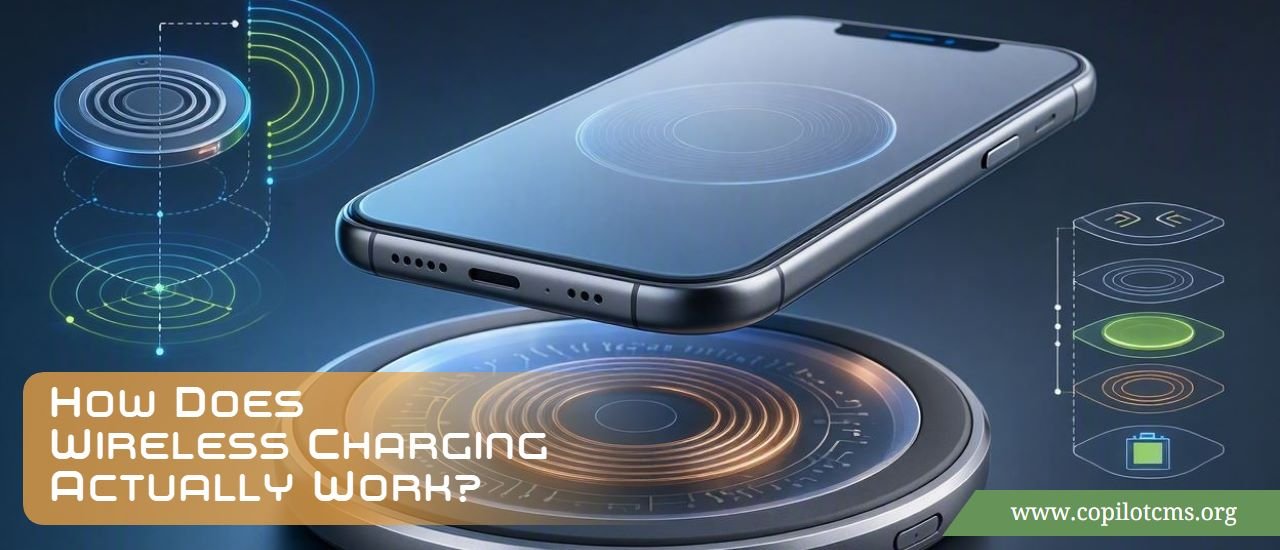
Put your phone on a charging pad, and somehow the battery starts filling up—without a cable plugged into the phone. It may look like magic, but wireless charging is really an elegant application of electricity, magnetism, and a little bit of clever engineering.
First, What Does “Wireless Charging” Mean?
Wireless charging means transferring electrical energy from a charger to a device without using a physical electrical connection between the two.
With ordinary wired charging, electricity travels through a cable from the charger to your phone. With wireless charging, the energy makes a very short journey through the air instead.
Importantly, the electricity doesn't simply float through the air like a radio signal carrying a message. Instead, most modern wireless charging systems use a changing magnetic field to transfer energy between two coils of wire.
The Real-World Version: Two Invisible Transformers
A useful way to understand wireless charging is to imagine two people passing energy without physically touching.
Imagine one person spinning a small wheel. The spinning motion creates a changing force around the wheel. Nearby, another wheel can respond to that changing force and begin spinning too—even though the two wheels aren't connected.
Wireless charging works somewhat like this, except the “wheels” are actually coils of wire and the invisible connection between them is a changing magnetic field.
In fact, wireless charging is closely related to something you may already know about: a transformer. Transformers transfer electrical energy between coils using magnetic fields. A wireless charger essentially separates those coils and places a small air gap between them.
What Is Inside a Wireless Charger?
Take apart a typical wireless charging pad conceptually, and you will find several important parts working together.
1. The Power Supply
The charging pad first receives electricity from a wall adapter or another power source.
The electricity supplied to the charger is usually ordinary electrical power that must be converted and controlled before it can be used by the wireless charging circuitry.
2. The Transmitter Coil
Inside the charging pad is a coil of wire. Think of it as a carefully arranged loop of electrical wire.
The charger's electronics send an alternating electrical current through this coil. Because the current is constantly changing direction, it creates a constantly changing magnetic field around the coil.
3. The Receiver Coil
Your phone contains another coil.
When the phone is placed close enough to the charging pad, the changing magnetic field produced by the charger's coil passes through the phone's coil.
That changing magnetic field induces an electrical current in the phone's coil.
4. The Charging Electronics
The electricity produced in the phone's receiver coil isn't immediately ready to charge the battery. The phone contains additional electronics that convert, regulate, and control that electrical energy.
Eventually, the controlled electrical power reaches the battery's charging system, which stores the energy inside the battery.
The Key Idea: Electromagnetic Induction
The scientific principle behind this process is called electromagnetic induction.
The basic idea is surprisingly simple: a changing magnetic field can produce an electrical voltage in a nearby conductor, such as a coil of wire.
This discovery is associated with the work of English scientist Michael Faraday in the 19th century. His experiments helped reveal the deep relationship between electricity and magnetism.
Wireless charging is one modern application of that same basic principle.
Step by Step: What Happens When You Put Your Phone on the Pad?
Let's follow the energy from the wall socket all the way into your phone's battery.
-
Electricity enters the charger.
The wireless charging pad receives electrical power from its power adapter.
-
The charger creates a changing current.
Electronic circuits control the electricity and send an alternating current through the charger's transmitter coil.
-
A changing magnetic field appears.
The changing current produces a changing magnetic field around the coil.
-
The magnetic field reaches the phone.
When the phone is positioned correctly, the magnetic field passes through the receiver coil inside the phone.
-
Electricity is induced in the phone's coil.
The changing magnetic field causes an electrical voltage to appear in the receiver coil.
-
The phone converts and regulates the electricity.
The phone's charging circuitry converts the received electrical energy into a form suitable for charging its battery.
-
The battery stores the energy.
The battery uses the electrical energy to increase its stored chemical energy.
So although there is no metal cable connecting the charger to the phone, energy is still being transferred through an electromagnetic field.
Why Does the Phone Have to Touch the Charging Pad?
Technically, wireless charging doesn't always require physical contact. The important requirement is that the two coils are close enough and properly positioned for efficient energy transfer.
However, the farther apart the coils are, the more difficult it becomes to transfer energy efficiently.
Think of two people trying to pass a basketball. If they stand close together, passing the ball is easy. If they move far apart, the pass becomes increasingly difficult and unreliable.
Wireless charging has a similar problem. The charger and phone need to be relatively close because the magnetic coupling between their coils becomes weaker as the distance increases.
Why Does Position Matter?
Have you ever put your phone on a charging pad and discovered that it isn't charging? One common reason is simple: the coils aren't properly aligned.
The transmitter coil in the charging pad and the receiver coil in the phone work best when they are positioned correctly relative to each other.
Imagine putting two small magnets near each other. Moving one sideways can change how strongly they interact. Wireless charging coils have a similar positional relationship.
This is why many wireless charging pads have a marked center or why charging stands are designed to hold the phone in a particular position.
Why Doesn't the Magnetic Field Charge Everything Nearby?
You might wonder: if the charger creates a magnetic field, why doesn't it charge everything sitting next to it?
The answer is that useful wireless power transfer requires the right kind of receiving circuitry and a properly designed receiver coil.
The phone's receiver coil is specifically designed to interact with the charger's changing magnetic field. The charging system also communicates and coordinates with the device so that power can be delivered appropriately.
A random object sitting beside the phone doesn't normally contain the necessary receiving system.
Wireless Charging Isn't Really “Power Through Nothing”
The word wireless can make the technology sound more mysterious than it is.
There is still plenty of hardware involved. The charger has coils, electronic circuits, sensors, and control systems. The phone has a receiving coil and its own charging electronics.
The only thing that has disappeared is the physical electrical connection between the two devices.
It's better to think of wireless charging as contactless energy transfer rather than electricity simply traveling freely through empty space.
What About Wireless Charging Standards?
Wireless charging isn't one single technology with one universal implementation. Different systems have been developed over the years.
One of the most important families of wireless charging technology is the Qi standard, which has been widely adopted for smartphones and other consumer electronics.
Newer generations of wireless charging standards have introduced improvements such as better alignment, communication between charger and device, higher power levels, and more sophisticated control.
The important point for a beginner is that a wireless charger and a device need to support compatible technology for the system to work properly.
How Does the Charger Know How Much Power to Send?
A wireless charger isn't supposed to blindly blast the maximum amount of power into your phone.
The phone and charger can communicate with each other using the wireless charging system's control mechanisms. The device can indicate that it is receiving power and provide information that helps the charger adjust its operation.
This allows the system to manage power rather than treating every device as if it had identical charging requirements.
It's similar to filling different-sized water containers. You wouldn't necessarily open a fire hose at full pressure for every container. A controlled flow makes much more sense.
Why Does Wireless Charging Sometimes Make the Phone Warm?
Heat is one of the important practical differences between wireless and wired charging.
Wireless energy transfer isn't perfectly efficient. Some of the energy is inevitably lost, and some of that lost energy appears as heat.
Heat can also result from resistance in electronic components and from the charging process itself.
That's why a phone may feel warmer while charging wirelessly, particularly when charging at higher power levels.
Wireless charging systems therefore use various methods to monitor and manage temperature and power. Your phone may also reduce charging power if conditions become too warm.
Why Isn't Wireless Charging 100% Efficient?
In an ideal world, every unit of electrical energy entering the charger would eventually end up stored in the phone's battery.
Real-world systems don't work that way.
Some energy is lost in the charger, some in the coils, some in the electronics, and some during the transfer between the coils.
Think about riding a bicycle. You put energy into the pedals, but not all of that energy becomes forward motion. Some is lost through friction, air resistance, and mechanical inefficiencies.
Wireless charging has its own equivalent sources of loss.
Does the Phone Battery Itself Receive Wireless Electricity?
Not directly.
This is an important distinction. The wireless system delivers electrical power to the phone's charging electronics. Those electronics carefully control how the battery is charged.
A modern rechargeable battery needs controlled charging. Simply connecting an uncontrolled electrical source to a battery would not be a safe or sensible way to charge it.
Your phone therefore acts as a kind of traffic controller between the incoming power and the battery.
What Happens If You Put Something Between the Phone and Charger?
This depends on the object.
A thin phone case may have little effect, which is why many wireless charging systems can work through compatible cases.
However, thick cases, certain materials, metal objects, magnetic accessories, or objects placed in the wrong position can interfere with charging.
Metal deserves particular attention. A metal object placed in a changing magnetic field can experience induced electrical currents. Depending on the design and circumstances, this can cause unwanted heating or interfere with charging.
For this reason, wireless charging systems are designed with detection and safety mechanisms, and manufacturers generally specify what kinds of cases and accessories are compatible.
Why Does a Wireless Charger Sometimes Stop Charging?
If wireless charging suddenly stops, there are several ordinary explanations.
The Phone Isn't Properly Aligned
The receiver coil inside the phone may not be positioned correctly over the charging coil.
The Case Is Interfering
A thick or incompatible case can increase the distance between the coils or interfere with the magnetic coupling.
The Charger Isn't Receiving Enough Power
The charging pad itself may need a sufficiently capable power adapter. A pad connected to an inadequate power source may not operate at its intended performance level.
The Phone Is Too Hot
Charging systems can reduce or stop charging temporarily when temperatures become too high. This is a protective measure rather than necessarily a sign that something is broken.
Something Is Between the Phone and Pad
A coin, metal object, accessory, or other unsuitable item can interfere with the charging process.
Why Does Wireless Charging Feel Slower Sometimes?
Wireless charging speed depends on several factors, including the phone, charger, power adapter, charging standard, alignment, temperature, and software or charging policies used by the device.
A wireless charger advertised with a certain maximum power level does not necessarily mean that every phone placed on it will charge at that speed.
It's similar to a highway with a high speed limit. The road may allow fast travel, but the car, traffic, weather, and road conditions still determine how fast you actually go.
Does Wireless Charging Damage the Battery?
Wireless charging itself isn't inherently a battery-damaging process. Modern phones are designed with charging management systems intended to control how their batteries are charged.
However, heat is important because excessive heat can contribute to battery aging over time.
Therefore, the practical question isn't simply “wired or wireless?” It is also about how much heat the particular charging setup produces and how the device manages that heat.
Many modern phones also use charging-management features that can slow or pause charging under certain conditions to reduce battery stress.
Wireless Charging vs. Wired Charging
Both methods ultimately deliver electrical energy to the same battery, but they take different routes to get there.
- Wired charging: electricity travels directly through a physical cable into the device's charging circuitry.
- Wireless charging: electricity is converted into a changing magnetic field, transferred across a short distance, and converted back into electrical energy inside the device.
- Wired charging: generally provides a very direct energy path.
- Wireless charging: offers convenience because you can place the device down without plugging in a connector.
- Wireless charging: can experience additional energy losses because the transfer occurs between separate coils.
Why Do People Like Wireless Charging?
The biggest advantage isn't that wireless charging somehow creates electricity more efficiently. Its main advantage is convenience.
Imagine having a small charging station on your desk. Instead of repeatedly finding a cable, orienting the connector, and plugging it into the phone, you simply put the phone down.
Pick it up when you need it, put it back when you're finished.
That small reduction in friction can make it easier to keep a phone charged throughout the day.
Where Else Is Wireless Power Used?
The same basic ideas aren't limited to smartphones.
Wireless power technology can be found in or explored for many other applications, including:
- Smartwatches and fitness devices
- Wireless charging cases for earbuds
- Electric toothbrush charging stands
- Some medical devices
- Industrial equipment
- Electric vehicle charging research and systems
The distance, power level, coil design, and control technology can be very different from one application to another, but the underlying concept—transferring energy using electromagnetic fields—can remain closely related.
What About Charging a Car Wirelessly?
The same general concept can be scaled up.
Instead of putting a tiny phone receiver coil over a charging pad, an electric vehicle can be positioned over a larger charging system built into or placed on the ground.
The transmitter and receiver coils can transfer energy across the gap between them.
The challenge is that an electric vehicle requires vastly more energy than a smartphone, so the equipment, power levels, thermal management, alignment, and safety requirements become much more demanding.
Is Wireless Charging Really Wireless?
There's a funny technical detail here: the charging pad itself still needs a cable.
So “wireless charging” doesn't mean the entire charging system has no wires.
It means the connection between the charger and the device being charged doesn't require a physical cable.
It's a little like a Wi-Fi router. Your router still needs electricity and usually has cables connected to it, but your phone can communicate with it without a network cable plugged into the phone.
Wireless Charging Is a Tiny Transformer With a Gap
If you want to remember only one technical idea from this article, remember this:
A wireless charger uses one coil to create a changing magnetic field, and another coil in the device uses that changing magnetic field to produce electrical energy.
That is the heart of the technology.
The rest—power control, communication, temperature monitoring, alignment, safety features, and battery management—is there to make this basic physical principle practical and safe for everyday devices.
Why This Matters
Understanding wireless charging gives you a useful example of how modern technology often combines simple scientific principles with sophisticated engineering.
The fundamental idea isn't new. Electricity and magnetism have been studied for centuries. What's impressive is how engineers have turned those principles into a tiny system that can sit underneath the back of your smartphone and transfer useful amounts of energy without a plug.
It also explains several everyday mysteries: why the phone needs to be aligned, why thick cases can cause problems, why the charger can become warm, why charging speed varies, and why the charger and phone need compatible technology.
The Takeaway
Wireless charging isn't electricity magically jumping from a pad into your phone. The charger sends a changing electrical current through a coil, creating a changing magnetic field. A second coil inside the phone detects that changing field and converts it back into electrical energy, which the phone's charging circuitry then uses to charge the battery.
In simple terms, wireless charging is like a transformer with the two coils separated by a small gap. Once you understand that one idea, the mysterious charging pad sitting on your desk becomes a lot less mysterious.